About Blitum bonus-henricus (L.) Rchb.
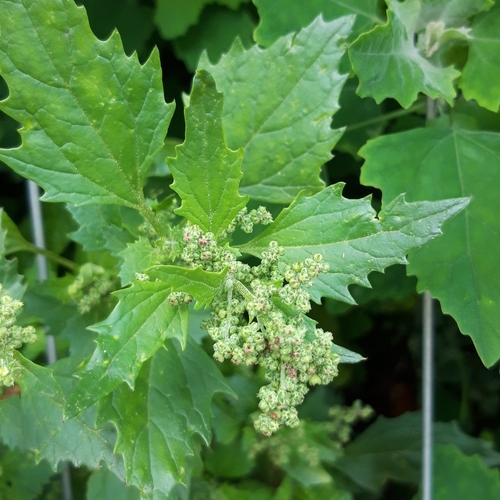
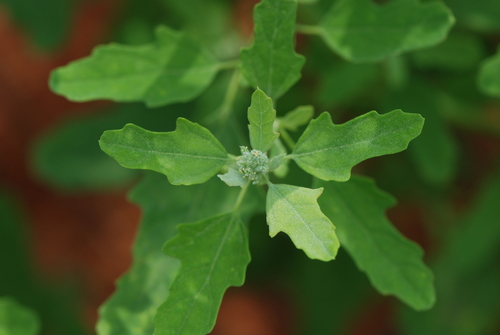
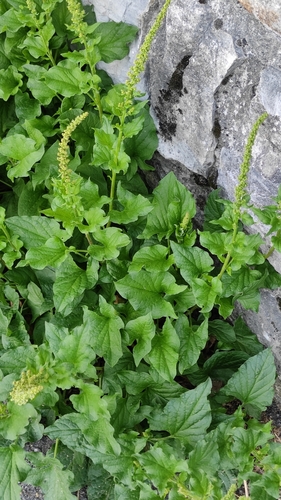
Blitum bonus-henricus (L.) Rchb., also known as Good-King-Henry, is an annual or perennial plant that grows up to 60 centimetres (24 inches) tall. Its leaves are 5–10 cm (2–4 in) long and broad, shaped from triangular to diamond-shaped, with a pair of broad pointed lobes near the base, and have a slightly waxy, succulent texture. Flowers grow in a tall, nearly leafless spike 10–30 cm (4–12 in) long; each individual flower is very small, 3–5 millimetres or 1⁄8–3⁄16 inch in diameter, greenish, and has five sepals. The seeds are reddish-green, and 2–3 mm in diameter. Good-King-Henry can be found across most of Britain and Europe, with the exception of southeast Britain and Europe. It is native to southern and central Europe, originating in the Alps, and later spread to lowlands, where it has been cultivated on a small scale. Its native range extends from southern Scandinavia, east to eastern Russia, and south to Mediterranean regions. Outside of Europe, it occurs as a neophyte in Morocco, North America, and New Zealand. Recently, natural populations of Good-King-Henry have been reported to decline in some countries including England and Germany. In parts of Germany, the wild form is so rare that the species is classified as endangered. In Germany, naturally occurring Good-King-Henry is found in two types of nutrient-rich biotopes: the alpine region, and ruderal sites such as wall bases and building corners. Populations at these ruderal sites have declined more steeply than those in alpine regions, so the species is considered more endangered at ruderal sites. Good-King-Henry acts as a host plant for several moth species. Moths commonly found interacting with the plant include Pelurga comitata (common name dark spinach) and Eupithecia simpliciata (common name plain pug), both of which belong to the Geometridae family. Moths from other families, including Noctuidae and Sphingidae, have also been recorded on the plant. Acting as a host for insects has dual effects for Good-King-Henry: insects can act as pollinators, which benefits the plant, but the larvae of some of these insects feed on the plant. Good-King-Henry is usually cultivated for its use as an alternative food source. Harvesting can start in spring. New shoots that appear (generally from mid-spring to early summer) can be thinned and cooked like asparagus; shoots are cut just under the ground once they reach 12 cm in height. All cutting must stop after this to let shoots develop further. Only when shoot harvesting stops after a few weeks can the plant recover and grow leaves, the part of the plant most traditionally used for food. The succulent, triangular leaves can be harvested a few at a time until the end of August, and eaten raw or cooked like spinach. Young leaves are the best for eating, as older foliage becomes fibrous, can develop a stronger bitter taste, and has higher oxalic acid content than small, young leaves. The flower buds can also be cooked. They are sometimes considered a gourmet delicacy, but their small size makes collecting a usable quantity very time-consuming. They are typically steamed similarly to broccoli. Rhizomes can be crushed to make confectionery that tastes like peanut butter. Though small, seeds are relatively easy to collect from mature plants. Because Good-King-Henry seeds contain saponins, hunting tribes have traditionally used the plant placed in streams or lakes to stun fish. After soaking and rinsing to remove saponins, the seeds are safe to eat. They can be ground into flour, which can be added to bread. Potential medicinal uses of Good-King-Henry have also been investigated. Recent studies have found that flavonoids extracted from Good-King-Henry have a neuroprotective effect. The plant is also used as an emollient, vermifuge, and gentle laxative. In folk medicine, it has been used to treat skin inflammations, abscesses, and anemia. For successful germination, Good-King-Henry seeds require a period of cold stratification; 9 weeks at 4°C is typically sufficient. After stratification, seeds can germinate at 20°C, so spring sowing is recommended. Germination difficulty may be caused by a thicker seed coat, which becomes thicker at higher altitudes. While Good-King-Henry grows best in fertile, humus-rich soil, it is highly adaptable and will grow in most soil types and conditions. It prefers partially shaded locations. When grown in suitable conditions, an estimated 30 plants produce enough food for four people. Good-King-Henry is exceptionally easy to cultivate because it has a clumping growth habit that limits its spread, and has a deep, descending taproot similar to a carrot. No pests are known to cause significant damage to the plant. Because it originates from the Alps, it can tolerate very low temperatures. For these reasons, it is considered a promising crop for the future. Currently, only a few cultivars are available, as it is mostly grown for domestic use. It does have the potential to be grown in monocultures if its seeds gain sufficient market value, and could help integrate more perennial crops into agricultural systems to improve agricultural sustainability.