About Blepharida rhois (Forster, 1771)
Blepharida rhois, commonly known as the sumac flea beetle, is most commonly found in North America. It is a herbivorous species belonging to the beetle family Chrysomelidae, and more specifically to the highly diverse subfamily Alticinae. This subfamily contains over 1000 species across 550 genera; its members are distinguished by enlarged metafemora and the ability to jump up to 100 times their own body length. This jumping ability lets them catapult away from approaching predators, which is how the common name "flea beetle" originated.
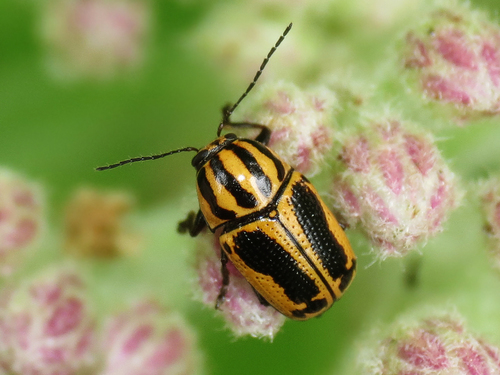
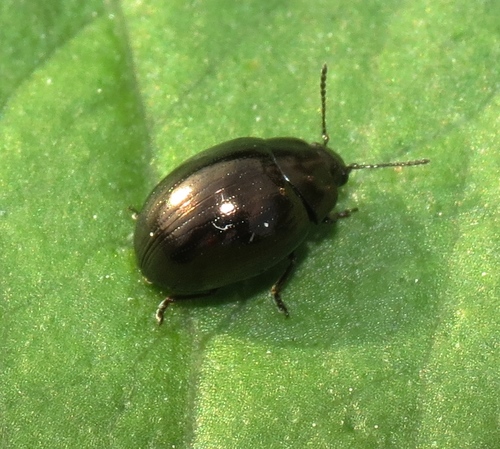
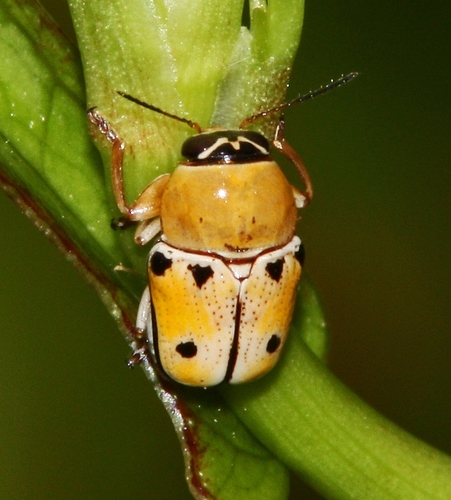
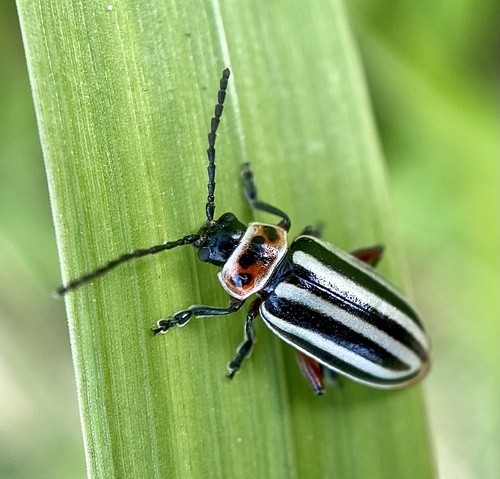
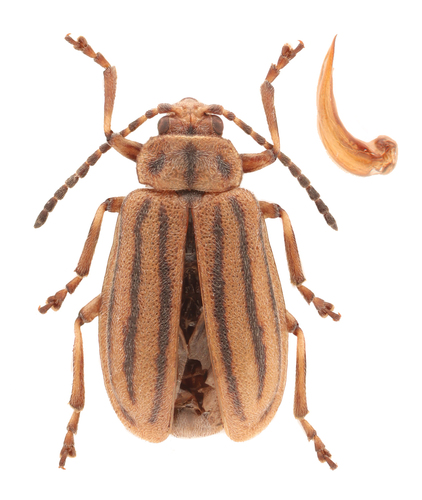
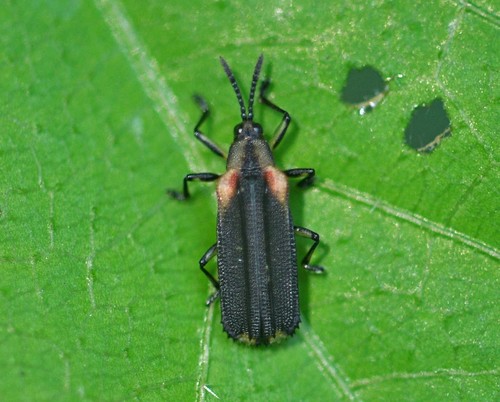
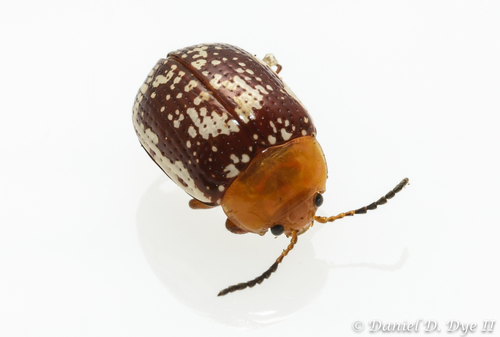
Both adult and larval sumac flea beetles are typically a quarter of an inch long. Adults are cream colored with irregular reddish patterns, while larvae are typically gray with yellow stripes. The species primarily feeds on the external surface of leaves from plants in the sumac genus Rhus. Larvae are able to digest useful chemical compounds from these leaves, which they use for chemical defense against predators. This defense is stored in a fecal shield, a key characteristic of B. rhois larvae. Because Rhus plants are required to produce this chemical defense, the geographic distribution of B. rhois often correlates with the presence of Rhus plants.
The genus Blepharida contains 73 distinct species: half are native to tropical Africa, and the other half are found in the New World tropics. Blepharida rhois has an outlying distribution, and is widespread across North America. It is most commonly found in the more northerly regions of the continent, with a range extending from Virginia to Alberta in the east, and as far west as Montana. This distribution is atypical, as all other Blepharida species live in Mexico and Central America.
Both adult and larval B. rhois are dietary specialists that feed exclusively on the sumac genus Rhus, and the species typically feeds exclusively on smooth sumac, Rhus glabra. Most New World Blepharida species feed on Bursera instead, so B. rhois is one of the few New World members of the genus that feeds on Rhus. The herbivory pattern of this beetle is extremely patchy: some areas of host plants become defoliated, while nearby areas remain untouched, a variation that may be caused by differences in secondary plant chemistry. Host and non-host plants differ in the amount of chemicals B. rhois larvae can incorporate into their defense, particularly the presence of tannic acid conjugates and phytol.
B. rhois typically feeds on the external surface of leaves. After emerging from the fecula 10 to 14 days, larvae crawl up the stems of Rhus plants to feed on the youngest leaf tissue or flower buds. Larvae feed alone on young leaflets, but may gather in lines to feed on older leaves. Because larvae cannot fly, lack a hard protective cuticle, and are vulnerable to predators while feeding, the chemical defense provided by their fecal shield deters attacking predators.