About Blastenia ferruginea (Huds.) A.Massal.
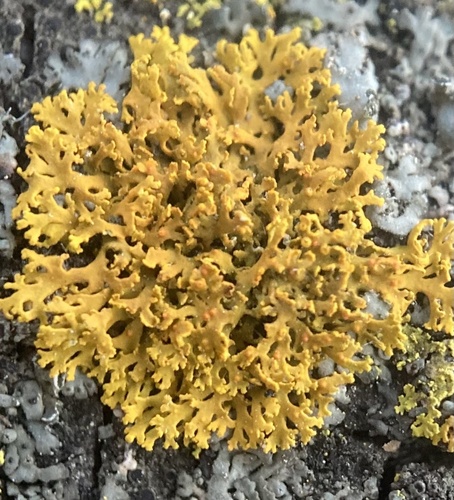
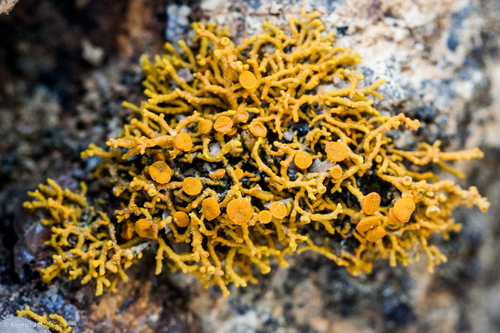
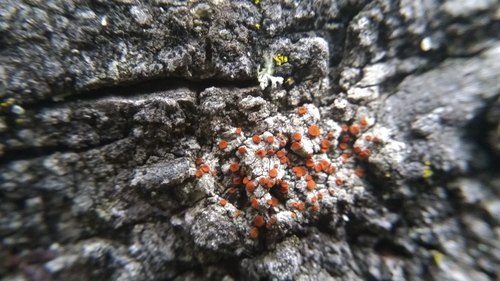
Blastenia ferruginea (Huds.) A.Massal. has a pale grey to dark grey thallus that is usually entire or immersed in host bark, with a thin profile. The thallus has a smooth texture and a white-grey hue, though it can sometimes appear darker, and it tests K−. Its apothecia are 1–2 mm in diameter, are rust red to reddish brown in colour, and often have a distinctly uneven, flexuose margin. Unlike the related species Blastenia crenularia, B. ferruginea has little or no photobiont beneath its hymenium, which is a distinguishing feature. It can also be told apart from its close relative Blastenia hungarica by apothecium size: B. ferruginea's apothecia typically measure 0.8–1.5 mm in diameter, while B. hungarica's apothecia are smaller, usually less than 0.6 mm across.
Blastenia ferruginea has a cosmopolitan distribution. It grows primarily on the bark of trees including hazel (Corylus), common aspen (Populus tremula), ash (Fraxinus), and Sorbus, and is occasionally found growing on old timber. In the United Kingdom, the species is scarce and appears to be declining; recent records are mostly from Northern and Western Scotland, Western Ireland, with sporadic occurrences in Cumbria, Hampshire, and Sussex. It has become rare or extinct across most of England, Wales, and Central Europe. In Belgium, it was considered locally extinct, having not been recorded since 1890, but it was rediscovered growing on willow (Salix) 120 years later. In Germany, the lichen is thought to have declined significantly during the second half of the twentieth century due to pollution, but as of 2018 it appears to be recovering. It was first recorded as new to tropical Africa in 2005, and had previously been reported from South Africa and Morocco.