About Biziura lobata (Shaw, 1796)
Scientific name: Biziura lobata (Shaw, 1796)
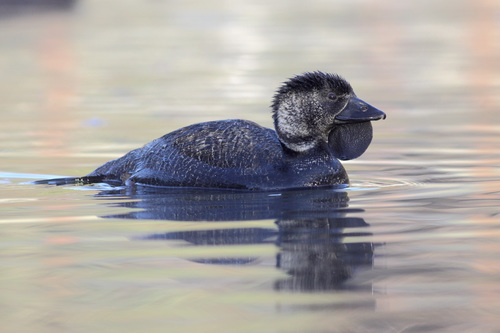
Description: Adult males of this species measure 60 to 70 cm (24 to 28 in) long, and have a distinctive large leathery lobe underneath the bill. Females are smaller, at 47 to 55 cm (19 to 22 in) long, and lack this lobe. Both sexes share drab dark grey-brown plumage that is slightly pin-striped, inconspicuous, and identical between males and females. On average, males weigh 2,398 g (5.287 lb) while females average 1,551 g (3.419 lb); the smallest recorded females weigh just 993 g (2.189 lb), and the largest recorded males reach up to 3,170 g (6.99 lb). On average, this is the second-heaviest diving duck species in the world, after the common eider. Male musk ducks are actually slightly heavier than male common eiders, but female common eiders are larger than female musk ducks, because common eiders have less extreme sexual size dimorphism.
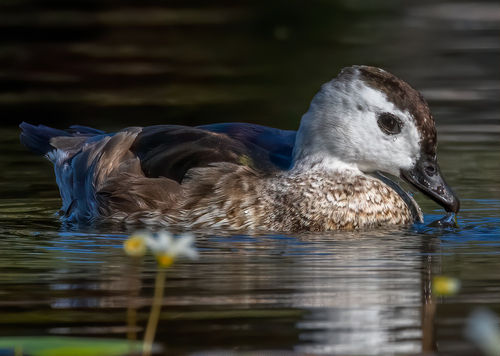
Musk ducks float very low in the water, similar to cormorants, and their large webbed feet are placed far back on the body. Newly hatched ducklings are covered in dark brown down. Within its native range, the musk duck's fanned tail is a key feature that distinguishes it from the freckled duck (Stictonetta naevosa), which shares similar size, coloration, and habits. The blue-billed duck (Oxyura australis) has a similarly shaped tail, but breeding plumage males of that species have a much richer chestnut brown main body color. However, nonbreeding males and females of blue-billed ducks are very similar in appearance to musk duck females, and cannot be reliably told apart from female musk ducks at a distance without close familiarity with subtle behavioral differences. Breeding season male musk ducks are almost always unmistakable due to their large bill lobe.
Ecology and status: This species prefers deep, still lakes and wetlands that have both open water areas and reed beds. They seldom leave the water, and move awkwardly on dry land. They rarely fly: taking off is difficult, and landing is a clumsy, low-angled process where they do not attempt to lower their feet. When they do need to fly, however, musk ducks can fly swiftly and for long distances, using rapid, shallow wing beats. In the water, musk ducks move with effortless agility, twisting and turning on the surface using both their feet and tail. In general, musk ducks stay in the water all day, alternating between loafing and active feeding, though they will sometimes come out to sit on a log or on dry land for short periods. They remain on the water at night, sleeping far from shore with their head tucked into their body or under a wing.
Musk ducks are well adapted to life below the water surface; they slip under head-first with barely a ripple, and can stay submerged for up to a minute at a time, often resurfacing only for a few moments before diving again. They dive to escape predators or unwanted company, and to search for food, typically in fairly deep water. They can descend to at least 6 m (about 20 ft). Their primary food items are water beetles, yabbies, freshwater snails and shellfish, and similar aquatic organisms. Their diet is supplemented with a variety of aquatic plants and a small number of fish.
When not breeding, adults are generally solitary. Adult males hold and defend territories, and exclude other males, and quite often females as well. Younger birds — juveniles and unmated adults — form flocks on larger bodies of water during some times of year. It is unknown at what age musk ducks reach sexual maturity in the wild, but it may take several years. They are a long-lived species, and remain capable of breeding when they are 20 years old or older.
Reproduction: The musk duck breeding season changes with rainfall and water levels, but it typically falls between July and January, with the largest number of clutches laid in September or October, which is austral spring. Despite a number of general studies, little is known about musk duck breeding behavior. During breeding season, the species gives off the musky odour that gives it its common name. In the breeding season, males advertise loudly with a repeating sequence of sounds: first, a ker-plonk splash created by their feet on the water surface, then two soft sharp cuc cuc calls, then a loud whistle and a deep grunt. This display sequence can start at any time of day or night, with or without an accompanying visual display, and can repeat every 4 or 5 seconds for as long as half an hour at a time.
Although male musk ducks have a large leathery lobe below the bill that swells during the breeding season, this lobe is not connected to the vocal cavities and appears to serve only a visual function. Mating is thought to be promiscuous, and quite possibly follows a lek system similar to that of the kākāpō, a very large flightless parrot found only in New Zealand, but this remains unconfirmed. The male does not take any part in building the nest or raising the young.
Females choose a secluded location for nesting, most often in tall reeds far from land and protected by deep water, or under the cover of overhanging shrubbery, but they will sometimes nest in a range of unusual places, such as on a tree stump, in a hollow log, or even under an upturned boat. The nest is a simple platform of trampled plant material with a slight central cup, lined with fine plant matter, and after eggs are laid, lined with plenty of down. Females appear unable to carry nest material, so they must use whatever material is within reach. Once the nest is complete, the female pulls down reeds from overhead to form a canopy that hides the nest from view. When she leaves the nest to feed, she slips quietly into the water and submerges, and does not surface until she is a long distance from the nest.
Clutch size is not definitively known: as many as 10 eggs have been found in a single nest, but this is likely the result of dump nesting, so three or four eggs is considered a more typical clutch size. In most cases, only one duckling survives to maturity, and sometimes two. Ducklings are able to swim and dive within a few days of hatching, after which they likely leave the nest. Young ducklings stay close to their mother for at least several months, and often ride on her back when they are very small. They can peck at food items on the surface and dive short distances even when quite small, but the mother continues to provide most of their food until they are almost fully grown.