About Bistorta vivipara (L.) Delarbre
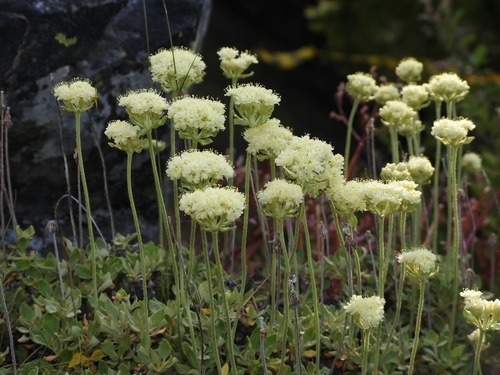
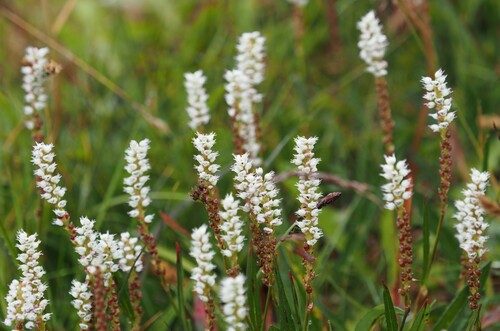
Alpine bistort, scientifically named Bistorta vivipara (L.) Delarbre, is a perennial herb growing 5 to 15 cm (2 to 6 in) tall. It has a thick rhizomatous rootstock and an erect, unbranched, hairless stem. Its leaves are hairless on their upper surfaces, but hairy and greyish-green on their lower surfaces. Basal leaves are longish-elliptical with long stalks and rounded bases; few upper leaves are linear and stalkless. Tiny white or pink flowers grow on the upper part of a spike, with five perianth segments, eight stamens with purple anthers, and three fused carpels. Flowers on the lower part of the spike are replaced by bulbils. Flowers rarely produce viable seeds, and reproduction normally occurs through bulbils: these small bulb-like structures develop in leaf axils and can grow into new plants. Very often, a small leaf develops while the bulbil is still attached to the parent plant. The starch-rich bulbils are a preferred food for rock ptarmigans (Lagopus mutus) and reindeer, and are also occasionally used by Arctic peoples. Alpine bistort blooms in June and July. It grows across many different plant communities, very often in abundance. Its typical habitats include moist short grassland, yards, track edges, and nutrient-rich fens. Like many other alpine plants, Alpine bistort is slow-growing and follows the process of flower preformation: it produces embryonic buds one year, which grow and open a few years after formation. An individual leaf or inflorescence takes three to four years to reach maturity from when its bud forms. Edible parts can be prepared in specific ways: bulbils can be stripped from lower flower stalks and eaten raw; young roots are edible raw, while older roots require cooking; young leaves can be eaten either raw or cooked. Roots are eaten in Russia, particularly by the Samoyed peoples.