About Bistorta plumosa (Small) Greene
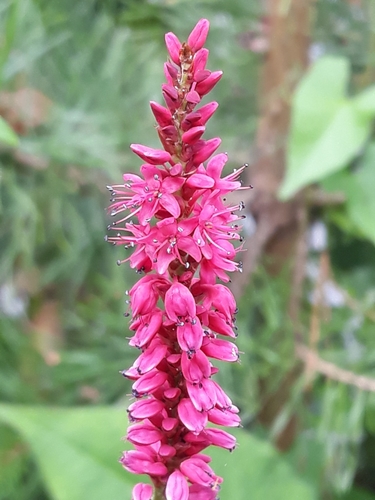
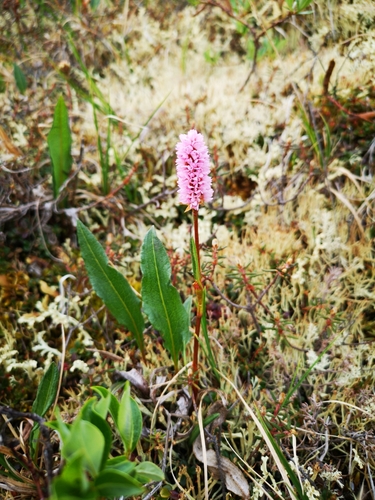
Bistorta plumosa (Small) Greene is a perennial herb that grows 10 to 40 cm tall from a dense, contorted rhizome. It produces simple alternate leaves with winged petioles that are sheathing at the base. Leaf blades are dark green on the upper surface, grey on the underside, commonly asymmetrical, and shaped lanceolate or ovate. Plants may have one to several stems, each ending in a cylindric to egg-shaped inflorescence that is usually more than 1 cm wide. Its flowers have tepals, stamens, and stigmas; tepals are oblong to elliptic with an obtuse or acute apex. Stamens may be exserted, and carry dark purple or black anthers. This species has an arctic-alpine distribution, and is endemic to Beringia, occurring in both Alaska and Siberia. It grows at elevations between 289 m and 1575 m, and is more commonly found on north-facing slopes. It is an important component of alpine tundra ecosystems. The leaves of Bistorta plumosa have high vitamin A and C content, and are eaten as a vegetable similar to spinach. Historically, Alaskan Natives used this plant as a dietary aid, and boiled its roots to add to stew. It has also been used as a model organism in plant physiology studies focused on carbon assimilation rates.