About Biston suppressaria (Guenée)
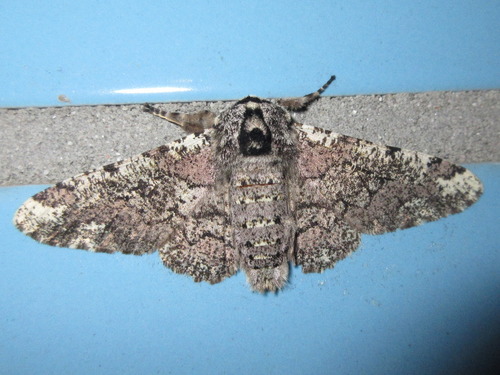
This moth species, Biston suppressaria (Guenée), shows measurable size differences between adult males and females. The male has a wingspan of 60–70 mm, while the female’s wingspan ranges from 74–80 mm. The adult moth has a more developed proboscis, a less hairy frons, and hind tibia with the first pair of spurs positioned medially. The outer margins of the wings are non-crenulate, meaning they are not scalloped. Male antennae are bipectinate, meaning comb-like on both sides, with short, stiff branches. The adult body is grey with fine black sprinklings, called irrorations. The head is ochreous, and yellow bars mark the thorax and abdomen. The forewings feature a waved yellow antemedial band. Both wings have an irregularly sinuous, indistinct yellow medial line that curves outward beyond the cell of the forewings. An ill-defined postmedial maculate band is angled at vein 5 on both wings, and extends along part of the outer margin of the forewings. A series of yellow spots runs along the margins of the wings. The larva of Biston suppressaria is most commonly dark green, with dark somital bands and a faint sub-lateral line. Its spiracles are white, ringed with red, and have red centers. The tubercle on the first somite and the larva’s legs are purple. Female larvae are much paler green than male larvae. Known host plants that Biston suppressaria larvae feed on include Cassia auriculata, Acacia, Albizia, Camellia sinensis, Chrysanthemum indicum, Dalbergia latifolia, Eucalyptus, Litchi chinensis, Mangifera indica, Paulownia tomentosa, Phyllanthus emblica, Prunus domestica, Prunus salicina, Psidium guajava, and Vernicia fordii.