About Bismarckia nobilis Hildebrandt & H.Wendl.
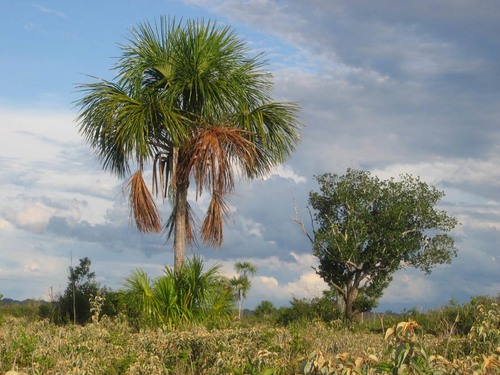
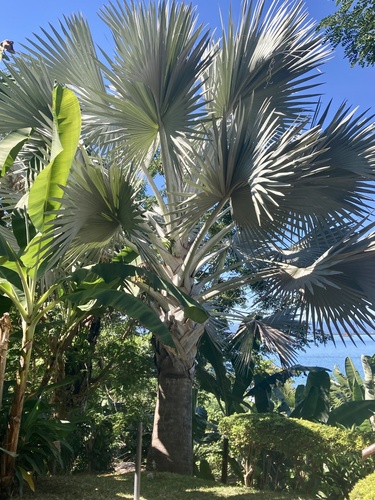
Bismarckia nobilis Hildebrandt & H.Wendl. is a palm that grows with a single solitary trunk, colored gray to tan, that displays ringed indentations left by old leaf bases. Trunks measure 30 to 45 cm in diameter, are slightly bulging at the base, and lose persistent old leaf bases on all sections except for the youngest parts of the tree. In its natural habitat, this species can grow over 25 meters tall, but cultivated individuals usually do not exceed 12 m in height. Mature trees produce enormous, nearly rounded leaves that grow over 3 m wide. The leaves are divided to one-third of their length into 20 or more stiff, once-folded segments that have split ends. The leaves are induplicate and costapalmate, forming a wedge-shaped hastula at the junction of the leaf blade and petiole. Petioles are 2–3 m long, slightly armed, and covered in white wax and cinnamon-colored caducous scales. The nearly spherical leaf crown is 7.5 m wide and 6 m tall. This palm is dioecious, and produces pendent, interfoliar inflorescences holding small brown flowers. On female plants, flowers mature into brown ovoid drupes, each containing a single seed. Bismarckia nobilis is native to Madagascar. The genus Bismarckia is monotypic, meaning it contains only this single species, with no recognized subspecies or taxonomic varieties. Madagascar itself hosts around 170 native palm species, 165 of which are found nowhere else. Within Madagascar, Bismarckia nobilis grows at elevations from sea level up to 800 m, across the plains and plateaus of the central highlands, and reaches nearly to the western and northern coasts. It grows in low grass savannas, usually in lateritic soil. Since much of this land has been cleared with fire for agricultural use, Bismarckia nobilis and other fire-resistant trees like Ravenala madagascariensis and Uapaca bojeri are the most conspicuous plants of this arid region. In horticulture, some growers distinguish two forms based on leaf color: the more commonly grown 'silver variety' and a 'green variety'. Some growers note that the green-leaved variety has less cold hardiness than the silver type. Bismarck palms are cultivated across the tropics and subtropics in suitable microclimates. They are grown in many parts of Indonesia and Australia, and used in landscaping in the United Arab Emirates. In the United States, they are planted in several areas of Florida, a few locations in Southern California, southern and southeastern Texas, and southern Arizona. This species is highly tolerant of drought, but also grows well in areas with high rainfall, and has moderate tolerance to sea spray. It tolerates a wide range of soils, but can develop potassium deficiency. Because of its very large leaf crown, it requires plenty of open space in landscape plantings.