About Bikkia tetrandra (L.f.) A.Rich.
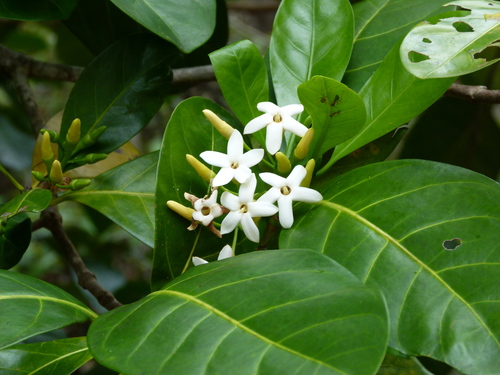
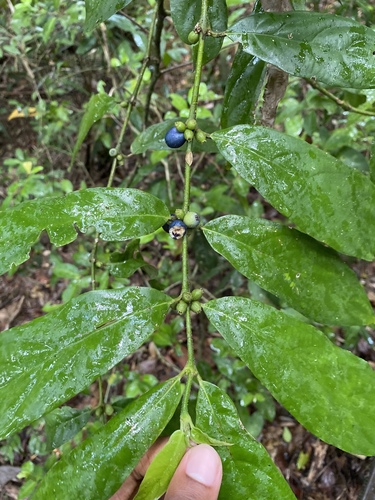
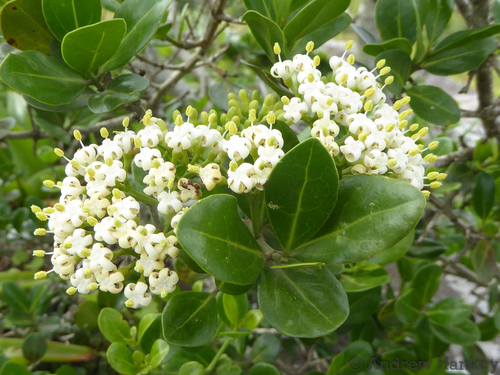
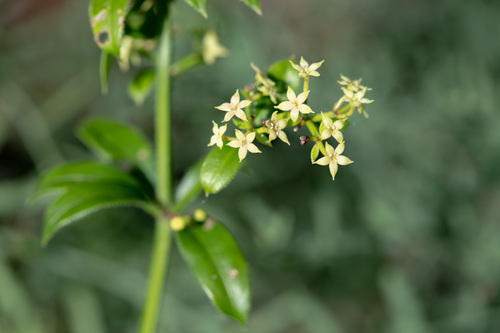
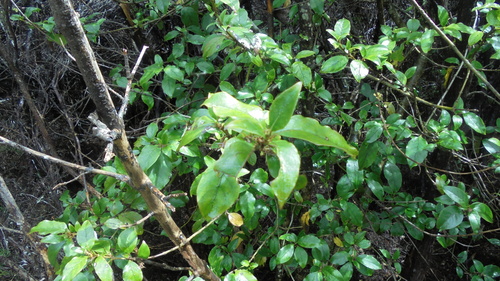
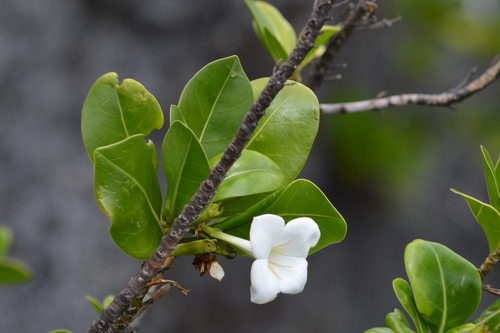
Bikkia tetrandra (L.f.) A.Rich. grows as an erect, branching shrub that occurs on sea-exposed limestone cliffs. Its stems have pale bark. Leaves grow in an opposite arrangement at the tips of branches, with every leaf pair offset from the pairs of leaves above and below it. The stipules are D-shaped with a small point, and leaves attach to the stem via short petioles. Leaves are unlobed, glabrous (smooth), obovate (narrower at the base than at the tip), with an obtuse angle at the tip and a pale midvein. Flowers grow in an axillary arrangement, meaning they bud from the junction between the leaf and stem, and are attached by 1 to a few short pedicels. The base of the flower has a four-toothed calyx. The flower itself is white, long tubular in shape, and expands outward at the end like a trumpet, with squared-off petals. It has four long anthers that do not extend beyond the flower. The fruit is an elongated, fibrous, woody capsule with 2 cells. Seed capsules of Bikkia tetrandra are much larger than those of other species in the Bikkia genus; an illustration provides a comparison, with Bikkia tetrandra (marked as #12) shown at a lower magnification than the other Bikkia species included. This species produces a large number of tiny black seeds.