About Bidens hyperborea Greene
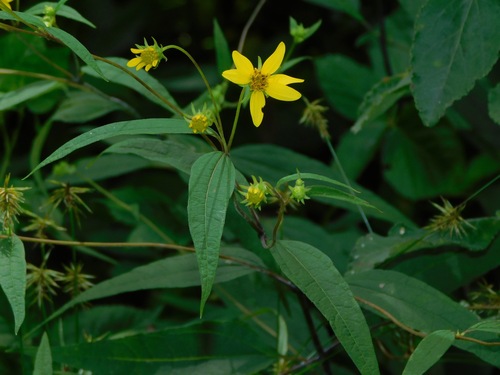
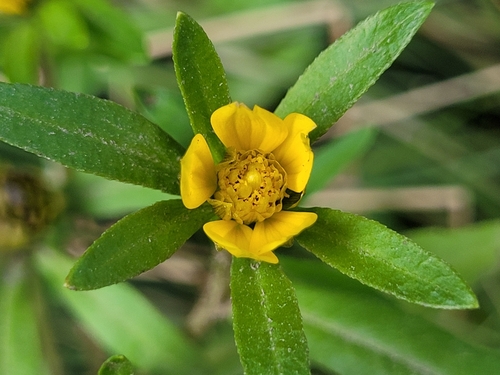
Bidens hyperborea Greene is an annual herbaceous plant with highly variable morphology. It usually grows 10–30 cm (3.9–11.8 in) tall, and occasionally exceeds 70 cm (28 in). Its leaves may be sessile or petiolate; when petiolate, petioles are 5–25 mm (0.20–0.98 in) long and more or less winged. Leaves range from oblanceolate to linear in shape, with cuneate bases, and margins that may be entire or more or less serrate. Leaf tips may be rounded, obtuse, or attenuate. Leaves usually measure 15–40 mm (0.59–1.57 in) long by 6–10 mm (0.24–0.39 in) wide, and rarely exceed 100 mm (3.9 in) in length. As a member of the Asteraceae family, Bidens hyperborea produces inflorescences called capitula (heads), compound structures that look like a single flower but are actually a receptacle holding many small individual flowers. These small flowers are divided into inner actinomorphic disc flowers, and outer zygomorphic ray flowers that resemble individual petals. The long flattened section of a ray flower corolla is called the lamina. The fruits of Asteraceae species are called cypselae, which have a modified calyx called a pappus attached. The receptacle is surrounded by the involucre, a whorl of overlapping bracts called phyllaries. In Bidens species, a second whorl of bracts called the calyculus sits just beneath the involucre; it is often longer than the phyllaries and more or less leaf-like. Bidens hyperborea flowers from August to October. Its capitula grow erect, and are borne solitary or in groups of 2 or 3 on peduncles 10–60 mm (0.39–2.36 in) long. The calyculus has 2 to 3 erect bracts, and rarely up to 9. These bracts are oblanceolate to lance-linear, usually have ciliolate margins, are abaxially glabrous, and typically measure 10–20 mm (0.39–0.79 in) long, rarely reaching over 75 mm (3.0 in). The involucre is more or less campanulate to cylindric, sometimes hemispheric, and 7–11 mm (0.28–0.43 in) in diameter. It usually holds 6 to 8 phyllaries (sometimes up to 12), which are oblong, have yellow tips, and measure 6–11 mm (0.24–0.43 in) long. Capitula may lack ray flowers, or have 3 to 7. Ray flower laminae are pale yellow and 4–12 mm (0.16–0.47 in) long. There are 15 to 30 disc flowers (sometimes up to 60), with yellow corollas that are sometimes orange-tipped, 3–4 mm (0.12–0.16 in) long. The cypselae are dark and striated, with a flattened, narrowly cuneate shape. Pappi are made of up to 4 erect awns 2–5 mm (0.079–0.197 in) long. Both the fruit margins and the awns are retrorsely barbed. Bidens hyperborea can easily be confused with other similar Bidens species, including some that grow alongside it. Bidens eatonii has stalked leaves, unlike the simple leaves of B. hyperborea. Bidens laevis and Bidens cernua have a broader mature disc (the central head section holding disc flowers) 1.3–2.8 cm (0.51–1.10 in) wide, which is nodding (cernuous) when fruiting, and their cypselae (achenes) have no conspicuous striation. In comparison, B. hyperborea has a smaller mature disc up to 1.5 cm (0.59 in) broad, remains erect when fruiting, and its cypselae have 5 to 17 conspicuous striations. Bidens hyperborea is native to northeastern North America, occurring in Canada (Ontario, Quebec, New Brunswick, and Nova Scotia) and the United States (Maine, New Hampshire, and Massachusetts). Fassett proposed that its wide but disjunct, ecologically narrow distribution formed toward the end of the Last Glacial Period. When freshwater released from the melting ice sheet of eastern North America entered the ocean, it created vast estuarine areas. As glacial melt flow diminished, these areas slowly retreated and became more saline, stranding the species in its remaining suitable habitats. Across its range, Bidens hyperborea grows in a variety of estuaries and associated intertidal habitats. Fassett described it as "...to be expected on the tidal shores of every fair-sized stream from the Merrimac to the St. Lawrence River...". It does not show strong preference for water temperature, as it grows in both warmer waters in its southern range and cooler waters of Hudson Bay. In Canada, this species occurs on the Atlantic and Arctic coasts, particularly at the mouths of tributaries that drain into James Bay and the St. Lawrence River, and along the coast of the Gulf of St. Lawrence to the Northumberland Strait. Populations of B. hyperborea on rivers entering the Gulf of St. Lawrence from eastern New Brunswick appear to be more tolerant of salinity than United States populations, and grow intermixed with Sagittaria (formerly classified as Lophotocarpus). It is absent from the outer coast of Nova Scotia and the Bay of Fundy, as the lack of freshwater flow on the outer coast and large tides in the Bay of Fundy create unsuitable conditions for its preferred estuarine habitat. In the United States, B. hyperborea has a more localized distribution, mostly concentrated in Maine, where it occurs along the coast at the mouths of rivers such as the Kennebec. It is also rarely found in Massachusetts, where it is reported from Essex County and Plymouth County, with only two remaining known occurrences. It is historically recorded from the Merrimack River and from New Hampshire, where it is likely extirpated. It has been reported from Hudson River estuaries in New York, but 2014 assessments indicate these records are misidentifications. Fassett identified a historical 1827 collection of Bidens from the Hackensack Meadowlands of New Jersey as B. hyperborea.