About Bidens frondosa L.
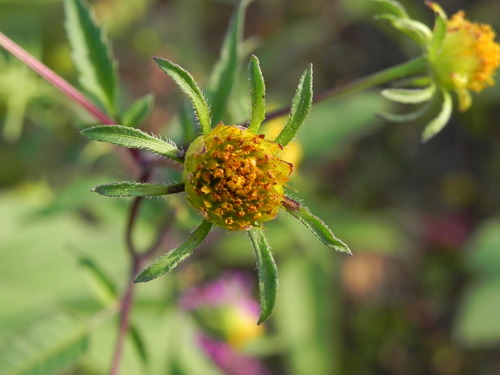
Bidens frondosa L. is an annual herb that typically grows 20 to 60 cm (8 to 24 inches) tall, and may occasionally reach up to 1.8 meters (6 feet) in height. Its stems have a square cross-section and may branch near the top. The leaves are pinnate, split into several toothed leaflets that are triangular or lance-shaped. Most leaflets are 6 to 8 cm (2 1/2 to 3 inches) long, and can exceptionally grow up to 12 cm (4 1/2 inches) long. Its inflorescence often holds a single solitary flower head, but may also form pairs or clusters of multiple heads. Each head contains many orange disc florets. Most flower heads do not have ray florets, but some may produce a small number of small yellow rays. The fruit is a flat, black or brown barbed cypsela that can reach up to one centimeter long, with two distinct hornlike pappi at one end. The barbed pappi on the fruit allow it to stick to animals, which helps facilitate seed dispersal. Bidens frondosa is native to northern North America. It is recorded as naturally present across the entire contiguous United States and Alaska, with the exception of Montana. It also occurs naturally in all of Canada except the three Arctic territories and Labrador. It does not naturally occur as far south as Mexico, though CABI records it as an introduced species there. The species has been widely introduced outside of North America, mostly to temperate climate regions. Most of these introductions were intentional, due to claims that the species has medicinal, herbal, and decorative properties. It was first introduced to Italy in the 1700s as an ornamental plant, and was first reported as a naturalised weed there in 1849. It is widespread across Europe, where it has been recorded in nearly every country except Finland, Sweden, and Greece. In Asia, it has been recorded in the Middle East (including Iran, Lebanon, Syria, and Turkey), the Caucasus, Central Asia, Western Siberia, China, Korea, Japan, and the Russian Far East. It has also been introduced to New Zealand and Morocco. Bidens frondosa grows best in locations with ample soil moisture and full sun, especially in areas where the existing plant community has been disturbed to leave bare ground. It can survive in water-saturated soils, and is frequently found growing at the edge of bodies of water, in drainage ditches, or on flood plains. The defoliating caterpillar of Hadjina chinensis, a species that feeds only on Bidens species, has been observed on Bidens frondosa.