About Bidens alba (L.) DC.
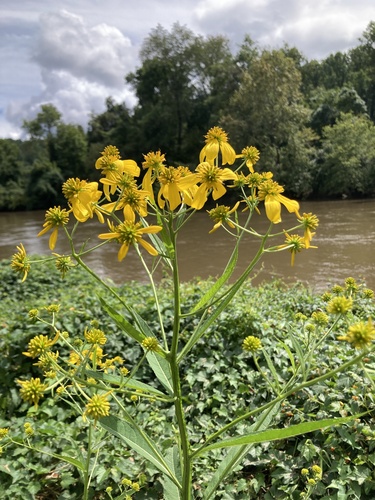
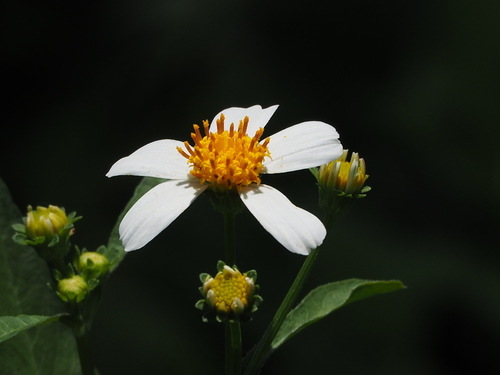
Bidens alba (L.) DC. is a vascular plant in the dicot family Asteraceae, with a root and stem system similar to other members of this family. After germination, its roots develop into a taproot that grows vertically downward. Primary tissue from apical meristems increases the plant’s length, while secondary roots from lateral meristems increase its width. Mature Bidens alba grows to a height of approximately five feet. The main stem emerges from the taproot, but bent stems at the base can also grow new roots from lower nodes. Stems are mostly hairless, and range in color from green to purplish. Vascular bundles deliver nutrients throughout the plant: xylem carries water from the roots, and phloem transports food made in the leaves. Bidens alba produces two leaves per stem node. Simple leaves grow on one side of the stem, and compound leaves grow on the opposite (underside) side. Leaves measure 2–10 centimetres (1–4 in) long and 1.0–3.5 cm (3⁄8–1+3⁄8 in) wide. Underside leaves are hairy, have toothed edges, and may be lobed depending on the variety; some leaves have toothed edges while others do not. The small flowering heads of Bidens alba are radially symmetrical. They have a daisy-like appearance, with larger white petals surrounding very small yellow flowers located at the ends of branches. Flower head color varies by subspecies: some have yellow, tubular central blossoms, while others have white or cream petals that are 1.5 cm (5⁄8 in) long. After flowering, the plant forms black linear seeds, producing approximately 1200 seeds per plant. Bidens alba is a fast-growing, fast-spreading weed, due to its very high seed production and ability to regrow from cut stems. In subtropical to tropical conditions, it can grow almost anywhere in full sun with little to no moisture. It grows best in loose soil high in organic matter, but it also propagates well on sand and limestone in non-irrigated habitats. Its seeds are dispersed primarily by animals or humans, though some seeds are also carried by wind and water. Bidens alba serves as a nectar source for butterflies and honeybees. It is a nutrient-dense wild plant with a nutrient profile similar to kale: it is high in fiber, protein, carotenes, folate, and magnesium. Zulu people in South Africa and people in India consume its fresh or dried leaves after boiling them. Young leaves of Bidens alba can also be eaten raw in salads. Bidens alba contains saponins, so older leaves may have an unpleasant taste and can cause stomach upset. Dried leaves of Bidens alba can also be used as a good tobacco substitute.