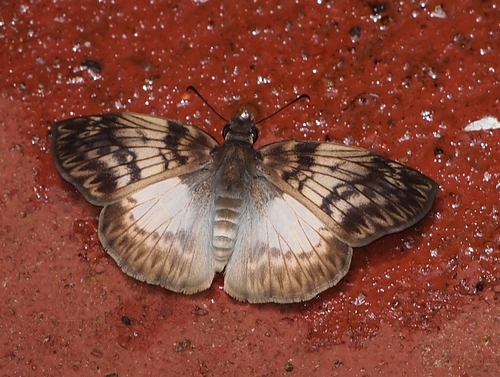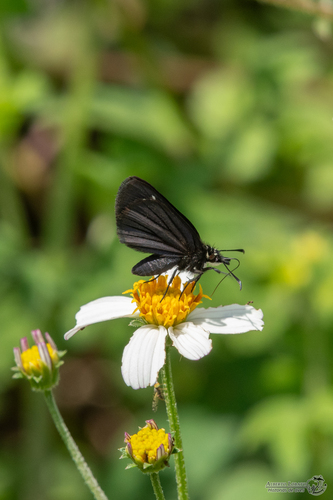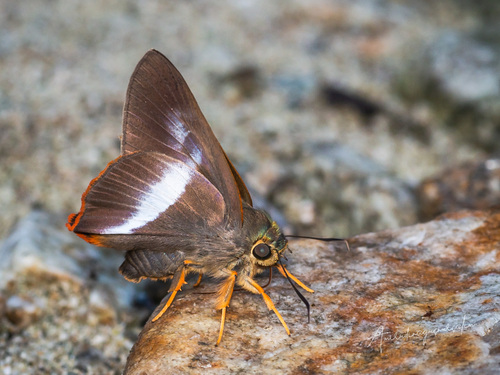
About Bibasis sena (Moore, 1865)
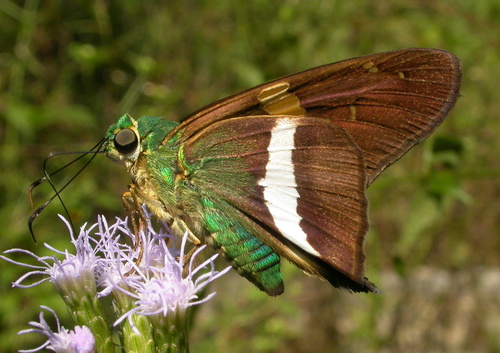
Bibasis sena (Moore, 1865) is a skipper butterfly species. For both sexes, the wingspan measures 45 to 50 mm. On the upper wing surface, both sexes are uniformly unblemished dark brown. The hindwings have an orange fringe, and the abdomen is orange toward its rear end. On the lower wing surface, the wings bear white patches: the forewings have a large white central patch, while the hindwings have a broad, pure white discal band. Males have no brands. A detailed description was published by Edward Yerbury Watson in 1891. Watson's description of the male notes that the upperside is dark chocolate brown, and the hindwing cilia are carmine-red. The underside is maroon brown; the forewing has a large buff-white patch extending from the middle of the posterior margin, bordered above with purple. The hindwing has a broad transverse purple white band that ends before the anal angle, with a sharply defined inner border and an outer border that suffuses across the disc. The cilia are also carmine-red. The palpi, front of the thorax, the underside of the body, and the anal tuft are dull yellow, and the underside of the thorax is greyish brown. Mr. Moore described the female in his "Lepidoptera of Ceylon" as having no differences from the male. This species is distributed across Sri Lanka, India, China's Hainan, Myanmar, Cambodia, Thailand, Laos, Vietnam, the Malay peninsula of Malaysia, the Indonesian archipelago including Borneo, Java, Kangean, Bali, Lombok, Bawean, Sumba, and Sumbawa, and the Philippines. Within India, it occurs in the Western Ghats including the Nilgiris, Kodagu, and Kanara, the Himalayas from Shimla eastward to Northeast India, extending into Myanmar where it has been recorded in the Karens and Dawnas, and it is also found in the Andaman and Nicobar Islands. The species' type locality is the Bengal region.