About Bibasis jaina (Moore, 1865)
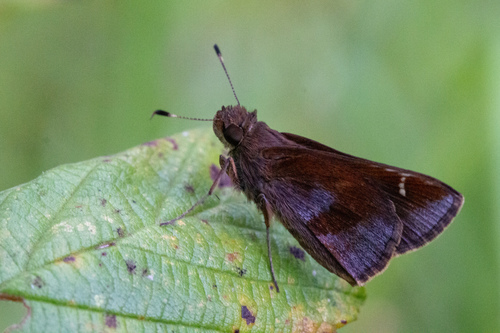
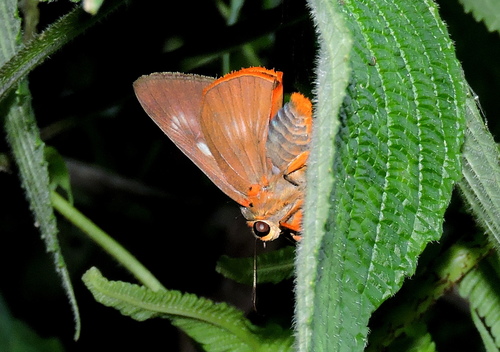
This butterfly species, Bibasis jaina, is commonly known as the orange awlet. For both sexes, the wingspan ranges from 60 to 70 mm. The upper side of the wings is dark vinaceous brown, the color of red wine. The forewing bears an orange costal streak that runs from the base above the cell to approximately halfway along the wing, and the hindwing has an orange fringe. The underside of the wings is paler, with orange bands along the veins of the hindwing.
Males may have an indistinct dark brand located centrally on the upper side of the forewing, between the middle of cell 1b and vein 3. A detailed 1891 description by Edward Yerbury Watson notes the following for males: On the upperside, the forewing has an orange-red subcostal basal streak and an indistinct blackish patch beneath the cell; the front of the thorax, anal tuft, and cilia of the hindwing are bright orange-red; the thorax and base of the abdomen are covered in bluish-grey hairs. On the underside, which is paler brown, both wings have a small black basal spot bordered by orange-red; the forewing has a well-defined purplish-white spot within the cell, a curved discal series of narrow, less defined spots, and a broadly yellow posterior margin; the hindwing has orange-red veins toward the abdominal margin and orange-red cilia, plus a curved, ill-defined series of narrow purplish-white discal streaks. The third joint of the palpi is brown, the underside of the thorax is greyish, and the middle of the abdomen underside, sides of the bands, and legs are orange-red.
Females are similar to males, but have darker bluish-grey hairs, and lack the orange-red subcostal streak and black discal patch found on males. The orange awlet occurs in India, Myanmar, Thailand, and Vietnam. Within India, it is found in the Western Ghats, and in the Himalayas from Garhwal (Mussoorie) eastwards through Sikkim and Assam to Myanmar. Its type locality is Darjeeling, West Bengal, India.