About Biancaea decapetala (Roth) O.Deg.
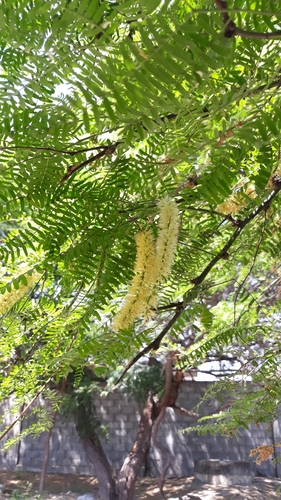
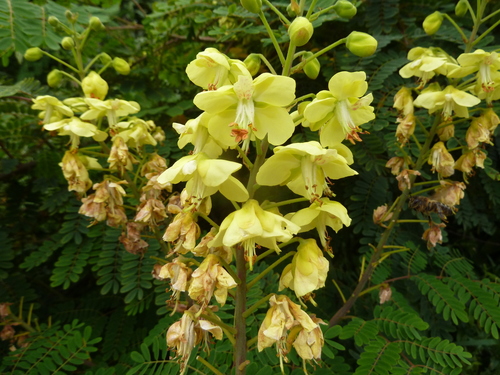
Biancaea decapetala is a robust, thorny, evergreen plant that typically grows as a 2–4 m (6.6–13.1 ft) tall shrub, or as a climber reaching 10 m (33 ft) or higher. It often forms dense thickets. Its stems are covered in minute golden hairs, and bear numerous straight to hooked thorns that are not arranged in regular rows nor confined to stem nodes. The leaves are dark green, paler on the underside, and not glossy; they grow up to 300 mm (12 in) long, with individual leaflets reaching up to 8 mm (0.31 in) wide. Its flowers are pale yellow, arranged in elongated, erect clusters that are 100–400 mm (3.9–16 in) long. Its fruits are brown, woody, flattened, unsegmented, smooth pods with a sharp beak at the apex, measuring about 80 mm (3.1 in) long. B. decapetala has been introduced to Fiji, French Polynesia, Hawai‘i, New Caledonia, Norfolk Island, Australia, China, Japan, Korea, Indonesia, Malaysia, Philippines, Thailand, Vietnam, Mauritius, Réunion, Rodrigues, Kenya and South Africa. It has become a seriously problematic invasive species in many of these locations. In Hawai‘i, where B. decapetala is known locally as pōpoki, it forms impenetrable brambles, climbs high into tree canopies, blocks access to pastures for animals, and obstructs forest pathways. Trailing branches produce roots when they come into contact with the ground. Its medium-sized seeds can be dispersed by rodents, granivorous birds, and running water. Commonly called Mauritius Thorn, this species was used in West African primate conservation to deter apes from entering farmland. However, this use is no longer recommended due to the species' invasive nature.