About Beyeria viscosa (Labill.) Miq.
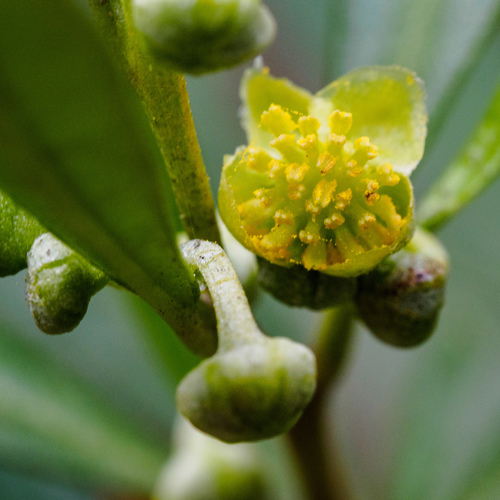
Beyeria viscosa, commonly called pinkwood, is typically a pyramidal shrub 3–4 meters (9.8–13.1 feet) tall, and rarely grows as a small tree up to 9 meters (30 feet) tall. This species is dioecious: individual plants are either male or female. Its leaves are arranged spirally, shaped oblong to oblanceolate, measuring 2–5 cm long by 5–15 mm wide, tapering toward the petiole, with flat or slightly recurved margins. The upper leaf surface is hairless, often sticky, while the lower surface is somewhat lighter in color. Male flowers are cream-yellow, clustered in groups of 2 or 3, have 4 mm long sepals, and bear numerous short stamens. Female flowers are solitary, lack petals, have 2–3 mm long sepals, a roughly globose ovary, and a large sessile stigma. Flowering occurs from December to February, through the peak of summer. The fruit capsules are glabrous or sparsely hairy, with a sticky coating similar to that found on leaves. They measure 6–8 mm long, and retain a 2 mm wide persistent stigma. Each capsule holds up to 3 smooth, oblong seeds, which usually germinate within 5–7 days after planting. As the common name suggests, the timber of B. viscosa has a pink hue similar to that of Nothofagus cunninghamii, but the plant’s generally small size makes it unviable as a timber tree. It responds well to pruning, and can be maintained as a hedge. Beyeria viscosa occurs across Australia except for the Northern Territory. It is most abundant in dry areas of central eastern New South Wales and eastern Tasmania, where it is a common understory shrub associated with eucalypts. It prefers poor, well-drained soils in semi-shaded sites, and is abundant in riparian habitats, gullies, and on rocky hills and ridges, where it can form dense stands.