About Beyeria lechenaultii (DC.) Baill.
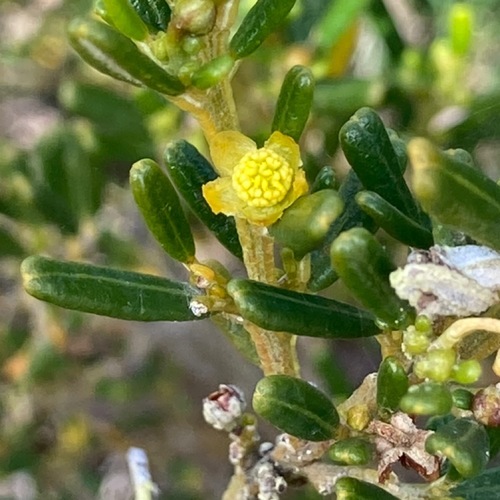
Beyeria lechenaultii is a sticky shrub that grows up to 1.5 meters (4.9 feet) tall. Its leaves range from oblong to linear, and their margins are sometimes recurved. The lower leaf surfaces are woolly, with the exception of the midrib. Male flowers occur in groups of one to three, growing on a sticky stalk that is 1–6 millimeters (0.04–0.24 inches) long, and the sepals of male flowers are more or less sticky. Female flowers grow singly on whitish stalks that lengthen as the plant develops fruit. The sepals of female flowers are whitish, and measure about 2 millimeters (0.08 inches) long. The stigma has 3 broad, recurved (curved backwards) lobes at its base. The plant's capsule is ovoid to globose, with the stigma remaining attached to the mature capsule. It typically produces three seeds, each around 5 millimeters (0.20 inches) long and reddish-brown in color. This species flowers in spring. In New South Wales, it most often grows as an understorey shrub within mallee communities. The Noongar people of southwest Western Australia drink decoctions made from the leaves of this plant to treat tuberculosis and fevers.