About Betula pubescens Ehrh.
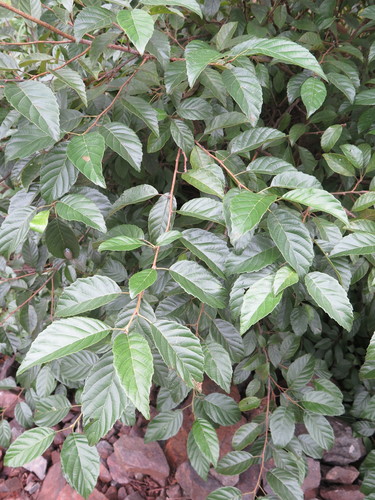
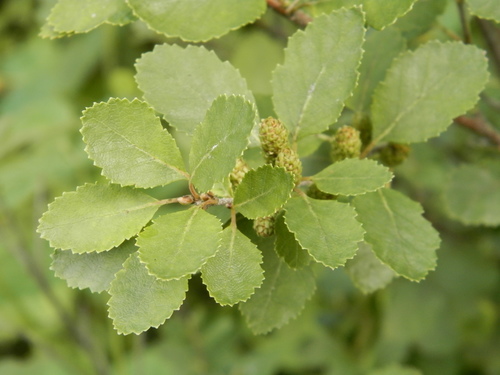
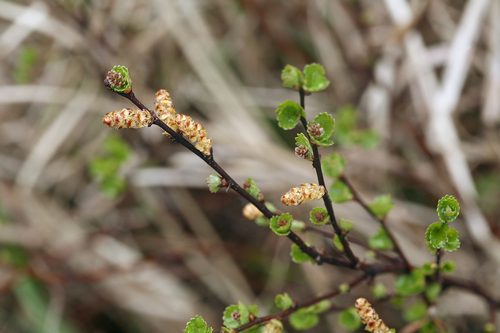
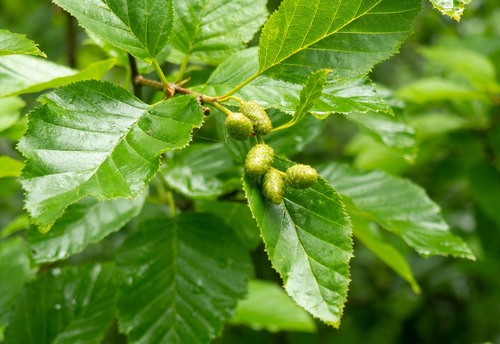
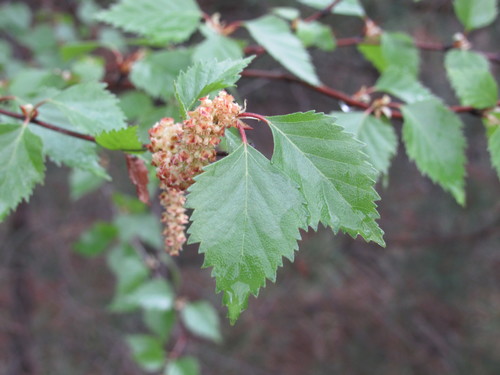
Betula pubescens Ehrh., commonly called downy birch, is also known by other common names including moor birch, white birch, European white birch, and hairy birch. It is a deciduous tree that grows 10 to 20 m (33 to 66 ft) tall, and rarely reaches 27 m. It has a slender crown and a trunk that can reach up to 70 cm (28 in) in diameter, exceptionally reaching 1 m. Its bark is smooth but dull grey-white, finely marked with dark horizontal lenticels. The shoots are grey-brown and covered in fine down. The leaves are ovate-acute, 2 to 5 cm (0.8 to 2.0 in) long and 1.5 to 4.5 cm (0.6 to 1.8 in) broad, with finely serrated margins. Its flowers are wind-pollinated catkins, produced in early spring before leaves emerge. The fruit is a pendulous, cylindrical aggregate 1 to 4 cm (0.4 to 1.6 in) long and 5 to 7 mm (0.2 to 0.3 in) wide that disintegrates when mature, releasing individual 2 mm (0.08 in) seeds that have two small wings along their sides.
B. pubescens is closely related to, and often confused with, silver birch (B. pendula). Many North American texts treat the two species as the same, causing confusion by combining downy birch's alternative common name white birch with B. pendula's scientific name, but the two are considered distinct species across all of Europe. Downy birch can be told apart from silver birch by its smooth, downy shoots—silver birch shoots are hairless and warty. Downy birch has dull greyish white bark, while silver birch has striking white, papery bark with black fissures. Leaf margins also differ: downy birch has finely serrated margins, while silver birch has coarsely double-toothed margins. The two also differ in habitat preferences: downy birch is more common on wet, poorly drained sites such as clay soils and peat bogs, while silver birch grows mainly on dry, sandy soils. In more northern areas, downy birch can also be confused with dwarf birch (Betula nana), as both species are morphologically variable. All three species can be distinguished by cytology: silver birch and dwarf birch are diploid (with two sets of chromosomes), while downy birch is tetraploid (with four sets of chromosomes). In Iceland, dwarf birch and downy birch sometimes hybridize, producing triploid plants (with three sets of chromosomes).
Betula pubescens has a wide distribution across northern and central Europe and Asia. Its range extends from Newfoundland, Iceland, the British Isles, and Spain eastwards across northern and central Europe and Asia all the way to the Lake Baikal region of Siberia. Its range extends southwards to around 40°N, with its southernmost limit in Turkey, the Caucasus, and the Altai Mountains. It is a pioneer species that establishes itself easily in new terrain distant from parent trees. This allows other woodland trees to become established, and the short-lived birch is eventually crowded out because its seedlings cannot tolerate shady conditions. Downy birch grows further north into the Arctic than any other broadleaf tree. Specimens from subarctic populations are usually small and very contorted, and are often classified as the variety arctic downy birch or mountain birch, B. p. var. pumila, which is not to be confused with B. nana. This variety is notable as one of the very few tree species native to Iceland and Greenland, and is the only tree that forms woodland in Iceland. It is thought that Iceland was once entirely covered in downy birch woodland, but today this cover is reduced to around one percent of the island's land surface.
In ecology, the larva of the autumnal moth (Epirrita autumnata) feeds on the foliage of Betula pubescens and other tree species. In years when moth populations reach outbreak levels, large areas of birch forest can be completely defoliated by the insect. Damage to leaf tissue stimulates the tree to produce chemicals that lower foliage quality, stunting larval growth and reducing larval pupal weights. In Greenland, around seventy species of fungi have been recorded growing in association with B. pubescens, as parasites or saprobes on living or dead wood. Some of the most common fungi include Ceriporia reticulata, Chondrostereum purpureum, Exidia repanda, Hyphoderma spp, Inonotus obliquus, Inonotus radiatus, Mycena galericulata, Mycena rubromarginata, Panellus ringens, Peniophora incarnata, Phellinus lundellii, Radulomyces confluens, Stereum rugosum, Trechispora spp., Tubulicrinis spp. and Tyromyces chioneus. Birch dieback disease, linked to the fungal pathogens Marssonina betulae and Anisogramma virgultorum, can affect planted downy birch trees, but naturally regenerated trees appear less susceptible. This disease also affects Betula pendula, and in 2000 it was reported at many sites planted with birch in Scotland during the 1990s.
Downy birch has a wide range of uses. The outer bark layer can be stripped from the tree without killing it, and used to make canoe skins, drinking vessels, and roofing tiles. The inner bark can be used to produce rope and a type of oiled paper. This inner bark is also rich in tannin, and has been used as a brown dye and a preservative. Bark can also be processed into high-quality charcoal preferred by artists. The flexible twigs and young branches make good whisks and brooms. The pale timber with a fine, uniform texture is used to manufacture plywood, furniture, shelves, coffins, matches, and toys, and for turnery. The Sami people of Scandinavia used bark from both B. pubescens and B. pendula as an ingredient in bread-making; the reddish phloem just below the outer bark was dried, ground, and blended with wheat flour to make a traditional loaf. In Finland, mämmi, a traditional Easter food, was historically packed and baked in birch bark boxes; today cardboard boxes are used, but they are printed with the characteristic birch bark pattern. Birch bark was even used as an emergency food during times of famine: in Novgorod in 1127–28, desperate people ate it alongside lime tree leaves, wood pulp, straw, husks, and moss. In Iceland, pruned trimmings from birch trees and birch sap are used to make a sweet birch liqueur. At one point, bark harvesting was so widespread that Carl Linnaeus expressed concern for the survival of downy birch woodlands. The leaves can be infused with boiling water to make a tea, and plant extracts have been used as herbal remedies. Both B. pubescens and B. pendula can be tapped in spring to collect a sugary fluid, which can be consumed fresh, concentrated into a syrup similar to the better-known maple syrup, or fermented into an ale or wine. In Scandinavia and Finland, this tapping is done on a small domestic scale, but in the former USSR (particularly Russia, Ukraine, Belarus, Estonia, Latvia, and Lithuania), birch sap is harvested commercially and used to manufacture cosmetics, medicines, and foodstuffs.