About Betula populifolia Marshall
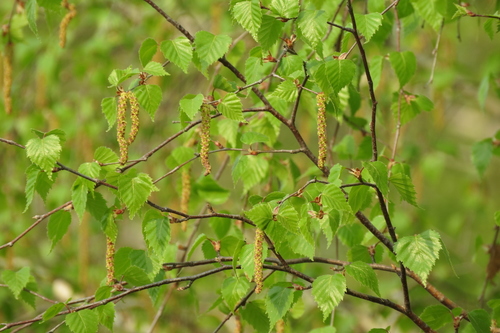
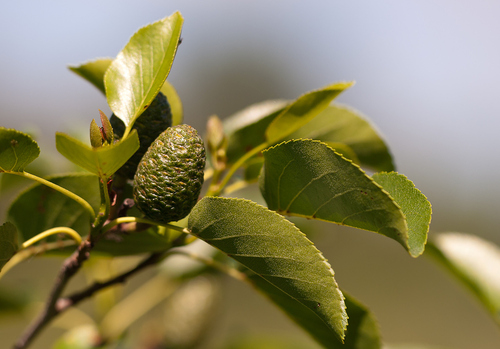
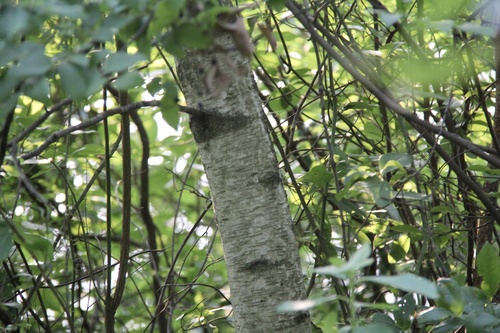
Betula populifolia, commonly called gray birch, is a small tree that reaches 20 to 30 feet (6 to 9 m) in height, with a diameter at breast height (DBH) of 4 to 8 inches (10 to 20 cm). It often grows with multiple stems, and forms a pyramidal crown with slightly drooping branches. Its bark is smooth, grayish-white or chalky, with visible lenticels and black triangular patches at the base of branches. Its bark is often mistaken for the bark of paper birch (Betula papyrifera), but gray birch bark does not peel (exfoliate) as easily as paper birch bark, making the two species distinguishable. It is also sometimes confused with quaking aspen (Populus tremuloides), which has similar bark but different leaves and buds. Gray birch twigs are slender, wiry, hairless, dull gray or brown, and have a warty or rough texture. Its buds are pointed, green-brown, shiny, coated with a gummy substance, and gray birch does not produce terminal buds. Its leaves are 2.5 to 3 inches (5 to 7 cm) long, arranged alternately, simple, pinnately-veined, and taper to an elongated tip. The upper leaf surface is dark green and glabrous, while the lower surface is paler, and leaf edges are doubly serrate. Like other species in the Betula genus, gray birch leaves turn yellow in autumn. Its flowers are wind-pollinated catkins that are 2 to 3 inches (5 to 8 cm) long: male catkins are pendulous, and female catkins are erect. The fruit matures in autumn, and consists of many tiny winged seeds packed between the catkin bracts. Gray birch occurs in the northeast United States and small parts of Canada. Its range extends from southeastern Quebec along the St. Lawrence River east to parts of New Brunswick and Nova Scotia, then south through New England and upstate New York to Pennsylvania and New Jersey. Disjunct populations also exist in Ohio, western Pennsylvania, Virginia, and North Carolina. It is listed as extinct in Delaware, extirpated in Illinois, and rare in Maryland. The species prefers well-drained loamy soils, but can also grow in drier gravelly soils. It tolerates poor, low-nutrient soils, which lets it establish in a wide range of habitats. It is classified as a pioneer species, because it is often one of the first tree species to colonize disturbed areas such as abandoned fields, burn sites, and abandoned mines. It is shade intolerant and grows best in full sunlight, but is eventually replaced by longer-lived, more shade-tolerant tree species. In regenerating stands, Betula populifolia is commonly found growing alongside other early successional species including paper birch, quaking aspen, and bigtooth aspen (Populus grandidentata). In other mixed stands, gray birch is most often associated with beech-birch-maple communities. Gray birch provides habitat and resources for many wildlife species. Several songbirds including blue jays (Cyanocitta cristata), black-capped chickadees (Poecile atricapillus), dark-eyed juncos (Junco hyemalis), and many other species eat gray birch seeds. Moose (Alces alces), white-tailed deer (Odocoileus virginianus), and snowshoe hares (Lepus americanus) browse its twigs, and while it is not their preferred food, beavers (Castor canadensis) will chew its bark. Like other North American birch species, gray birch has high resistance to the bronze birch borer (Agrilus anxius). This resistance developed because North American birches share a coevolutionary relationship with the borer. Even with this resistance, bronze birch borers can still damage gray birch trees if the trees are already weakened by other factors. Between approximately 1930 and 1950, large numbers of gray birch, along with paper birch and yellow birch (Betula alleghaniensis), were weakened by birch dieback disease. This allowed bronze birch borers to attack and kill the trees. Gray birch is a common landscape and ornamental tree. It is widely used for this purpose because of its tolerance of a wide range of soils, resistance to bronze birch borers, small size, and attractive bark coloration. Whitespire is a common ornamental cultivar that has whiter bark than naturally occurring gray birch. Gray birch can also act as a nurse tree for smaller, more economically valuable pines that need protection to become established. Before European colonists arrived in North America, the indigenous Iroquois and Mi'kmaq peoples used the inner bark of gray birch to treat infected cuts and wounds.