About Betula papyrifera Marshall
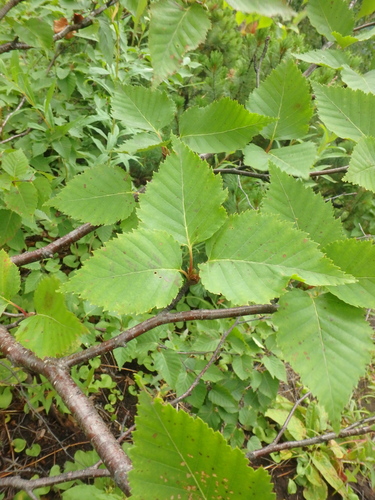
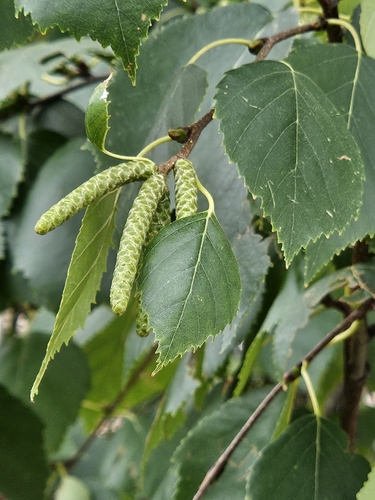
Betula papyrifera Marshall, commonly called paper birch, is a medium-sized deciduous tree. It typically reaches 20 meters (66 feet) in height, with exceptional specimens growing up to 40 meters (130 feet), and trunks can reach up to 75 centimeters (30 inches) in diameter. When growing in forests, it usually forms a single trunk; when planted as a landscape tree, it may develop multiple trunks or branch close to the ground. Paper birch is generally a short-lived species. It does not tolerate heat and humidity well: individuals in zones 6 and warmer often live only 30 years, while trees in colder climates can live for more than 100 years. This species can grow in a wide range of soil types, from steep rocky outcrops to the flat muskegs of the boreal forest, with best growth occurring in deeper, well-drained to dry soils depending on location. On mature trees, the bark is characteristically bright white, and flakes off in fine horizontal strips to reveal pinkish or salmon-colored inner bark. It often has small black marks and scars. On trees younger than five years, the bark is brown-red with white lenticels, making it difficult to distinguish from other birch species. The bark is highly weather-resistant due to its high oil content, which gives it waterproof properties. When a paper birch falls, its wood often rots away leaving hollow bark completely intact. The leaves are dark green and smooth on the upper surface, and typically have fine hairs (pubescence) along the veins on the lower surface. They are alternately arranged on stems, oval to triangular in shape, 4–10 cm (2–4 in) long and around two-thirds as wide. Leaves are rounded at the base, taper to a sharply pointed tip, and have a doubly serrated margin with relatively sharp teeth. Each leaf attaches to the stem via a petiole around 2.5 cm (1 inch) long. In fall, leaves turn bright yellow, contributing to the vivid autumn coloration of northern deciduous forests. Leaf buds are small, conical, green with brown edges. Young stems are reddish-brown and may be slightly hairy. Paper birch is monoecious, meaning a single individual produces both male and female flowers. These flowers are wind-pollinated catkins. Female catkins are greenish, 3.8 cm (1½ in) long, and grow from twig tips. Male (staminate) catkins are 5–10 cm (2–4 in) long and brownish. Flowering occurs from mid-April to June, depending on location. Fruit matures in autumn, and consists of numerous tiny winged seeds packed between catkin bracts. Seeds are released between September and spring. Trees begin producing seed at 15 years of age, and reach peak seed production between 40 and 70 years of age. Seed production is irregular: a heavy seed crop is typically produced every other year, though at least some seeds are produced every year. In average seed years, 2,500,000 seeds per hectare (1,000,000 per acre) are produced, while bumper crop years can produce up to 86,000,000 seeds per hectare (35,000,000 per acre). Seeds are light enough to be blown by wind to new locations, and can also blow along the surface of snow. Roots are generally shallow, confined to the upper 60 cm (24 in) of soil, and do not form taproots. High winds are more likely to break the trunk of a paper birch than to uproot the entire tree. Betula papyrifera is mostly restricted to Canada and the far northern United States. It is found in interior (var. humilus) and south-central (var. kenaica) Alaska, all provinces and territories of Canada except Nunavut, and the far northern continental United States. Isolated populations occur as far south as the Hudson Valley of New York and Pennsylvania, northern Connecticut, and Washington. High-elevation populations also grow in mountains of North Carolina, New Mexico, and Colorado. The southernmost stand in the western United States is in Long Canyon, within the City of Boulder Open Space and Mountain Parks, which is an isolated Pleistocene relict that most likely marks the southern extent of boreal vegetation during the last Ice Age. In Alaska, paper birch often grows naturally in pure stands, or mixed with black or white spruce. In the eastern and central parts of its range, it is often associated with red spruce and balsam fir, and may also grow alongside big-toothed aspen, yellow birch (Betula populifolia), and maples. Common shrubs associated with paper birch in the eastern part of its range include beaked hazel (Corylus cornuta), common bearberry (Arctostaphylos uva-ursi), dwarf bush-honeysuckle (Diervilla lonicera), wintergreen (Gaultheria procumbens), wild sarsaparilla (Aralia nudicaulis), blueberries (Vaccinium spp.), raspberries and blackberries (Rubus spp.), elderberry (Sambucus spp.), and hobblebush (Viburnum alnifolium). The wood of Betula papyrifera is moderately heavy and white. When properly seasoned, it makes excellent high-yield firewood, with a dried wood density of 37.4 lb/cu ft (0.599 g/cm3) and an energy density of 20,300,000 BTU/cord (5,900,000 kJ/m3). While it does not have very high overall economic value, it is used to make furniture, flooring, popsicle sticks, pulp for paper, plywood, and oriented strand board. The wood can also be crafted into spears, bows, arrows, snowshoes, sleds, and other traditional items. When used for paper pulp, non-trunk wood produces less fiber of lower quality with reduced mechanical strength, but it is still suitable for paper production. Paper birch sap can be boiled down to make birch syrup. Raw sap contains 0.9% carbohydrates (glucose, fructose, sucrose), compared to 2–3% carbohydrates in sugar maple sap. Sap flows later in the season than sap from sugar maples. Today, only a small number of small-scale operations in Alaska and Yukon produce birch syrup from this species.