About Betula occidentalis Hook.
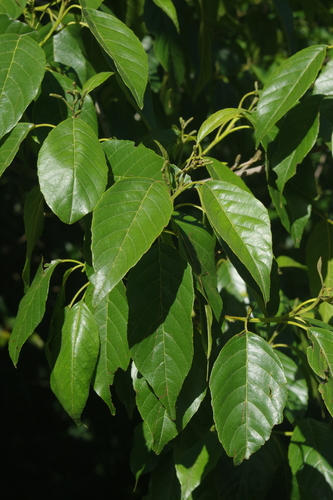
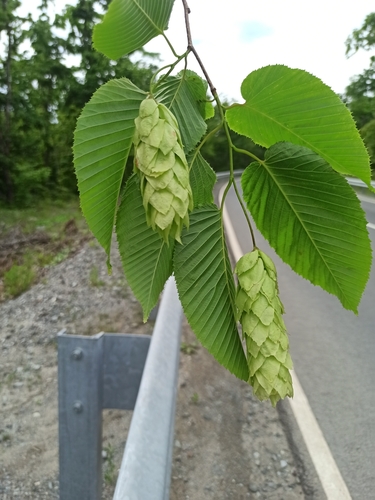
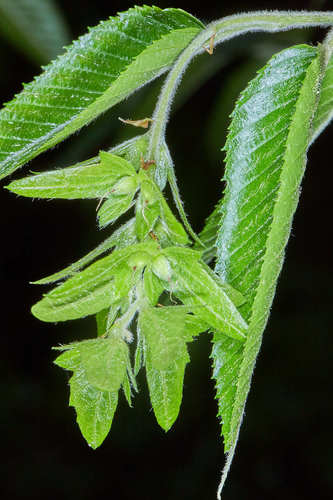
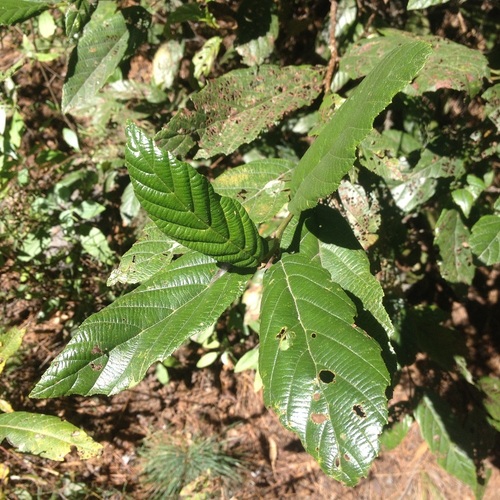
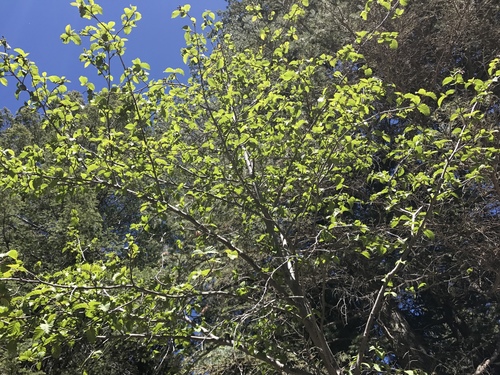
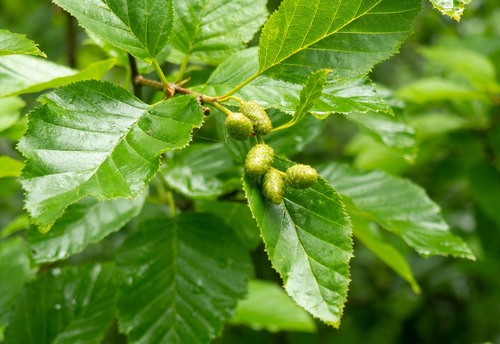
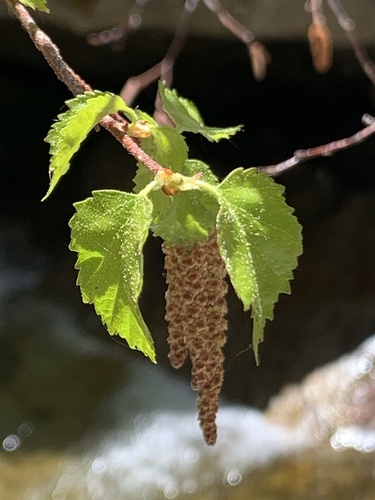
Betula occidentalis, commonly known as water birch or red birch, is a birch species native to western North America. In Canada, its range extends from Yukon east to northwestern Ontario, extending southwards; in the United States, it grows from eastern Washington east to western North Dakota, south to eastern California, northern Arizona, northern New Mexico, and also occurs in southwestern Alaska. It most commonly grows along streams in mountainous areas, sometimes reaching elevations of 2,100 metres (6,900 feet), and generally grows in drier habitats than paper birch. This deciduous species grows as a shrub or small tree, reaching up to 14 m (46 ft) in height and up to 25 centimetres (10 inches) in trunk diameter. It tends to produce epicormic growth, with many small limbs sprouting from the trunk that leave the wood full of small knots. Its bark is dark red-brown to blackish, smooth and does not peel. Its twigs are hairless or thinly hairy, and have no scent when scraped. The leaves are arranged alternately, shaped ovate to rhombic, measuring 1–7 cm (1⁄2–2+3⁄4 in) long and 1–4.5 cm (1⁄2–1+3⁄4 in) broad. They have serrated margins, two to six pairs of veins, and a short petiole up to 1.5 cm (1⁄2 in) long. Its flowers are wind-pollinated catkins 2–4 cm (3⁄4–1+1⁄2 in) long; male catkins are pendulous, while female catkins are erect. The fruit measures 2–3 cm (3⁄4–1+1⁄4 in) long and 8–15 millimetres (1⁄4–1⁄2 in) broad, and is made up of many tiny winged seeds packed between the catkin bracts. The classification of similar birch populations found in Alaska is disputed: some authorities include these populations within B. occidentalis, while others consider them hybrids between Betula neoalaskana and Betula glandulosa. A 2023 study sequenced chloroplast genomes of Betula genus species for phylogenetic analysis, and found that among sampled Betula species, B. occidentalis is most closely related to B. pendula 'Purple Rain' and B. platyphylla. Sheep, goats, and birds browse the foliage of this birch, and some small bird species also eat its seeds. Several Plateau Indian tribes used water birch to treat pimples and sores. As a riverside tree native to the western United States, B. occidentalis responds to water stress by maintaining an isohydric strategy.