About Betula nigra L.
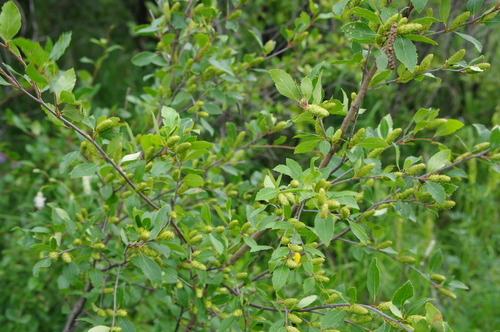
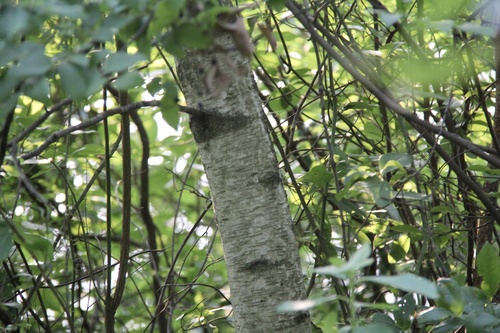
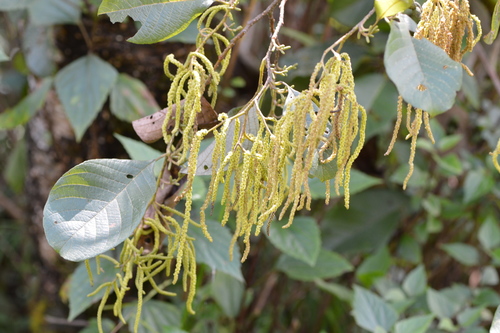
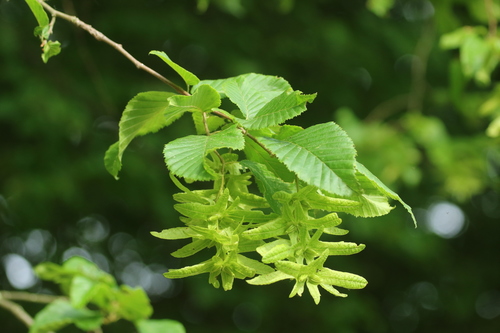
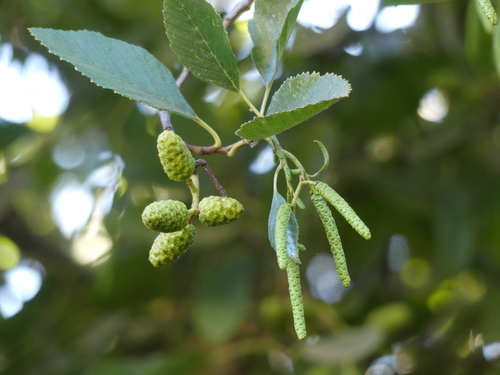
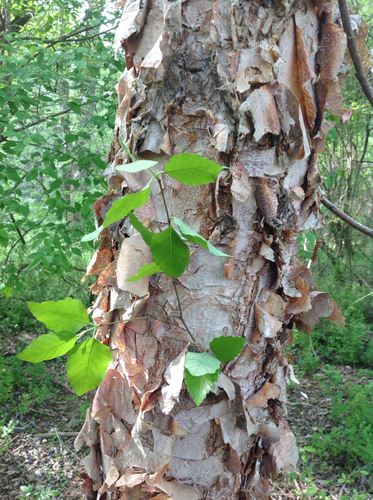
Betula nigra L., commonly called river birch, is a deciduous tree that reaches 25 to 30 meters (80 to 100 ft) in height, with a trunk 50 to 150 centimeters (20 to 60 in) in diameter. The base of the tree often divides into multiple slender trunks. Bark characteristics change across the tree’s youth, mature, and old growth stages. Young river birch bark ranges from salmon-pink to brown-gray, and forms loose layers of curling, paper-thin scales. As the tree matures, the salmon-pink color is replaced by reddish-brown over a dark grey base. Mature bark scales no longer curl loosely, instead packing closely into thick, irregular plates that sit slightly separated from the trunk and can shift outward to the side. In old growth past maturity, bark scales become thicker toward the trunk base and are split by deep furrows. Twigs are either hairless or thinly hairy. This species lacks terminal buds, and lateral buds typically have a hooked tip, a trait that distinguishes it from other species in the Betulaceae family. Its leaves are alternate and ovate, measuring 4 to 8 centimeters (1+1⁄2 to 3+1⁄4 in) long and 3 to 6 centimeters (1+1⁄4 to 2+1⁄4 in) broad, with a serrated margin and five to twelve pairs of veins. The upper leaf surface is dark green, while the underside is pale yellow-green; leaves turn yellow in autumn. Flowers are wind-pollinated catkins 3 to 6 centimeters (1+1⁄4 to 2+1⁄4 in) long: male catkins are pendulous, while female catkins are erect. Unusually for birches, its fruit matures in late spring. The fruit is made of many tiny winged seeds packed between the catkin bracts. River birch occurs at low elevations, ranging north from New Hampshire south to northern Florida, extending west to Kansas and east to the Atlantic coast where suitable habitat exists. As its common name suggests, it grows along streambanks, and it can also be a dominant species in forested wetland communities and areas with moist soil such as floodplains. It is documented in the following U.S. states: Alabama, Arkansas, Connecticut, Delaware, Florida, Georgia, Illinois, Indiana, Iowa, Kansas, Kentucky, Louisiana, Maryland, Massachusetts, Mississippi, Missouri, New Hampshire, New Jersey, New York, North Carolina, Ohio, Oklahoma, Pennsylvania, South Carolina, Tennessee, Texas, Virginia, West Virginia, and Wisconsin. It grows best in USDA hardiness zones 4 through 9. In regions with prevalent mining, river birch is often used for land reclamation and erosion control, because it tolerates acidic soils that are unsuitable for other hardwood species. In West Virginia, it has been observed colonizing mine refuse sites after seed is blown in from neighboring areas. Since the species grows primarily on floodplains and along streambanks, it is moderately tolerant of flooding; saplings have been recorded surviving up to 30 days of continuous flooding in some regions. While it tolerates excess water, it is intolerant of shade, and seeds cannot germinate without abundant direct sunlight. Many native bird species use river birch: waterfowl use its dense cover for nesting sites, while ruffed grouse and wild turkey eat its seeds. Deer graze on young saplings and low, reachable branches. River birch is a larval host plant for over fifteen moth species, including Acronicta betulae, Acrobasis betulivorella, Bucculatrix coronatella, Nemoria bistriaria, Nites betulella, Orgyia leucostigma, and Pseudotelphusa betulella. Though native to wet ground, river birch can grow on higher ground, and its distinctive bark makes it a popular ornamental landscape tree. Several cultivars selected for garden planting have much whiter bark than the wild type, including 'Heritage' and 'Dura Heat'. These cultivars are the only white-barked birches resistant to the bronze birch borer (Agrilus anxius) in warm areas of the southeastern United States. Historically, Native Americans used boiled river birch sap as a sweetener similar to maple syrup, and ate the inner bark as a survival food. Knotting means the species is not widely used for commercial lumber, but its strong, close-grained wood is sometimes used locally to make furniture and woodenware, and as fuel.