About Betula alleghaniensis Britton
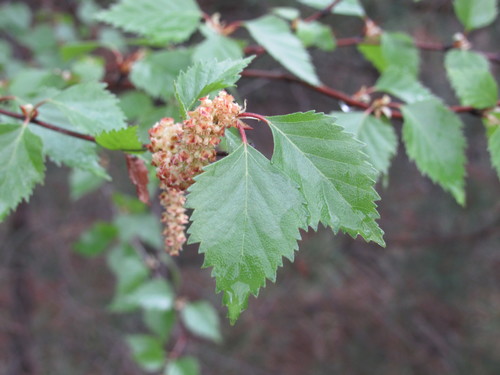
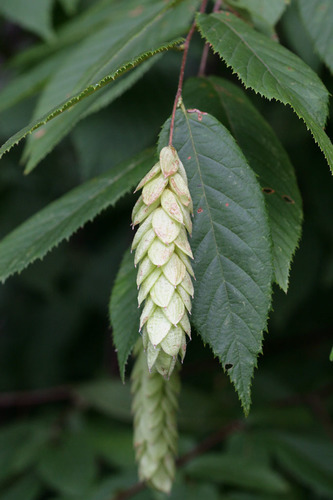
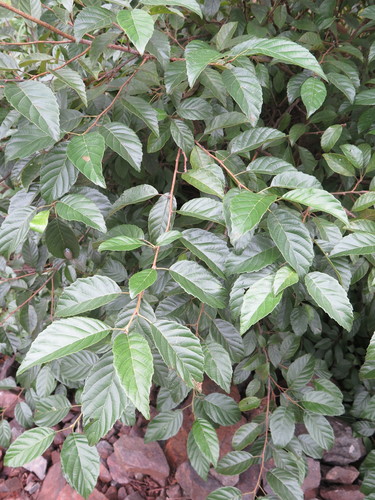
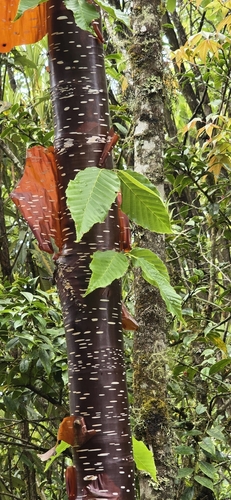
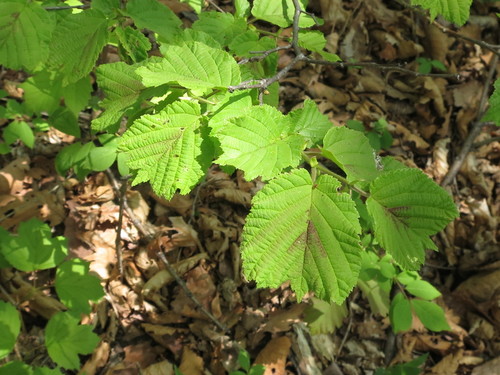
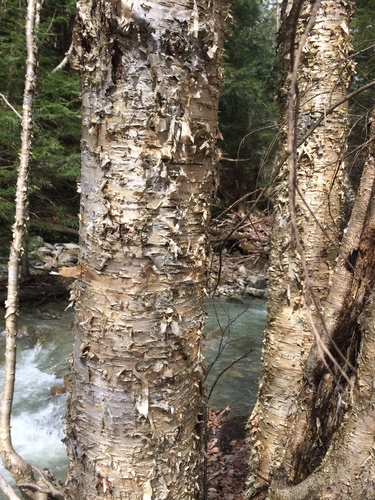
Betula alleghaniensis Britton, commonly known as yellow birch, is a medium-sized deciduous tree that is typically single-stemmed. It is the largest birch species native to North America, usually growing 18 to 24 meters (60 to 80 feet) tall with a trunk 0.61 to 0.91 meters (2 to 3 feet) in diameter, and can exceptionally reach 30 meters (100 feet) in height. This is a long-lived species, with a typical lifespan of 150 years, and some old-growth specimens can live up to 300 years. Yellow birch reproduces mostly by seed. Mature trees usually begin producing seeds around 40 years old, but may start as early as 20 years. The optimal age for seed production is around 70 years. Good seed crops do not occur annually, instead they form every 1 to 4 years, with very little seed produced in intervening years. Seeds germinate best on mossy logs, decaying wood, or cracks in boulders, because they cannot penetrate the leaf litter layer. This growth pattern can create unusual forms: for example, yellow birch roots often grow around a tree stump, and once the stump rots away, the tree is left standing on stilt-like roots. Yellow birch saplings cannot establish in full shade under a closed forest canopy, so they generally require forest disturbance to establish and grow. The tree is fairly deep-rooted and produces several long lateral roots. The bark of mature yellow birch is shiny yellow-bronze, and flakes and peels in fine horizontal strips. It often has small black marks and dark horizontal lenticels. Once the tree reaches a trunk diameter greater than 0.30 meters (1 foot), the bark typically stops shredding and reveals a platy outer bark, though thinner branches still retain shreddy bark. An uncommon alternate form, f. fallax, grows in the southern portion of the species' range, and has darker gray-brown bark that shreds less than the typical form. When scraped, yellow birch twigs have a faint scent of wintergreen oil, though this scent is much less strong than that of the related sweet birch (Betula lenta) — the only other North American birch that also produces a wintergreen scent. The strength of this scent is not considered a reliable identification trait on its own, and must be combined with other characteristics to confirm identification. The leaves of yellow birch are arranged alternately on the stem. They are oval with a pointed tip, and often have a slightly heart-shaped (cordate) base. They measure 5.1 to 12.7 centimeters (2 to 5 inches) long, and are typically half as wide as they are long, with a finely doubly serrated margin. The upper leaf surface is dark green, while the lower surface is lighter, and the lower veins are covered in fine hairs (pubescent). Leaves grow either singly or in pairs from small spur shoots, and turn bright yellow in autumn. The leaf petiole is very short, only 1 to 1.5 centimeters (1/4 to 1/2 inch) long. Yellow birch is monoecious, meaning both male and female wind-pollinated catkins grow on the same tree. Catkins open in late spring. Male catkins are 5 to 10 centimeters (2 to 4 inches) long, yellow-purple, and pendulous (hanging downward). They grow in groups of 3 to 6 on growth produced the previous year. Female catkins are erect (pointing upward), 1.5 to 3 centimeters (5/8 to 1 1/8 inches) long, and oval-shaped. They grow from short spur branches alongside new leaves. The fruit matures in autumn, and consists of numerous tiny winged seeds packed between the catkin bracts. Each seed is a winged samara with two wings that are shorter than the seed is wide, and seeds mature and are released in autumn.
Yellow birch's native range extends from Newfoundland, Prince Edward Island, Nova Scotia, New Brunswick, southern Quebec and Ontario, and the southeast corner of Manitoba in Canada, west to Minnesota in the United States, and south along the Appalachian Mountains to northern Georgia. While its range reaches as far south as Georgia, it is most abundant in the northern portion of its range. It is rare in southern Pennsylvania, where it is generally only found along water bodies in cool, mature woods; from Maryland southward, it only occurs at high elevations. It grows in USDA hardiness zones 3 through 7. It prefers cool growing conditions, and is often found on north-facing slopes, swamps, stream banks, and rich woods. It does not grow well in dry regions or regions with hot summers, and typically only lives 30 to 50 years in these conditions. It tolerates soil pH ranging from 4 to 8.
In its ecosystem, white-tailed deer, moose, and cottontail rabbits browse yellow birch twigs; deer also eat many saplings, and can limit the species' regeneration if deer populations are too high. Ruffed grouse and various songbirds eat yellow birch seeds and buds. Because the tree has thin bark, yellow-bellied sapsuckers feed on it by drilling holes to collect sap. Broad-winged hawks show a preference for nesting in yellow birch in New York. Multiple species of Lepidoptera, including the mourning cloak (Nymphalis antiopa) and the dreamy duskywing (Erynnis icelus), feed on yellow birch as caterpillars. Yellow birch is often found associated with eastern hemlock across its range, as both species share similar habitat preferences. It mostly grows at elevations between 0 and 500 meters (0 to 1640 feet), but can grow as high as 1000 meters (3300 feet). It is most prominent in the transition zone between low-elevation deciduous forests and high-elevation spruce-fir forests. Because of its thin bark and lack of ability to resprout, it is easily killed by wildfire. Sugar maple (Acer saccharum) produces allelopathic chemicals that reduce the growth of yellow birch seedlings. The inhibitory chemical is released from sugar maple roots, and has a very short soil half-life, losing all effect on birch after 5 days.
Yellow birch is considered the most commercially valuable birch species for lumber, and is the most important hardwood lumber tree in eastern Canada. Its wood is widely used for flooring, furniture, doors, veneer, cabinetry, gun stocks, and toothpicks, and was once popular for manufacturing wagon wheels. Most birch wood sold in North America comes from this species. Yellow birch wood is relatively strong, heavy, and has a close grain. Its color ranges from reddish brown to creamy white, it accepts stain well, and can be worked to a high polish. Like most birch wood, yellow birch rots quickly because it tends to trap moisture. Native Americans historically collected cellulose from rotting yellow birch logs to use as quick tinder for starting fires. In the past, yellow birch was used to distill wood alcohol, acetate of lime, tar, and oils. Oil of wintergreen can be distilled from its bark. The papery shredded bark is very flammable due to its high oil content, and can be peeled off and used as a fire starter even when wet. Like sugar maple, yellow birch can be tapped for syrup. While its sap has lower sugar content than sugar maple sap, it flows in greater quantities. When boiled down, wintergreen compounds evaporate, leaving a syrup similar in flavor to maple syrup; the sap can also be used directly to make birch syrup, or infused with additional flavor. Tea can be made from yellow birch twigs and inner bark.