About Bertholletia excelsa Bonpl.
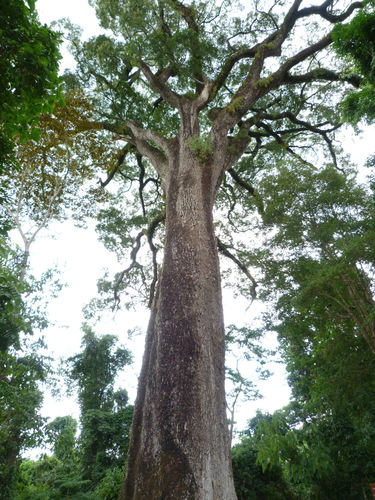
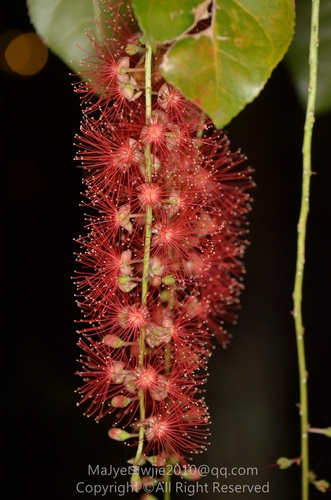
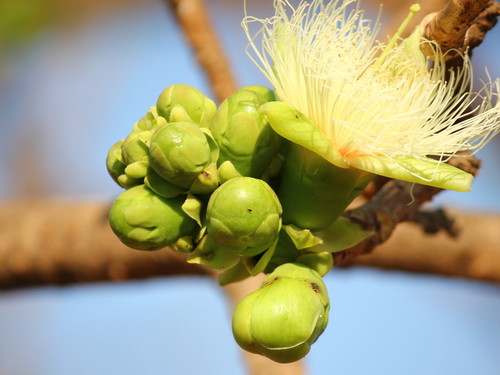
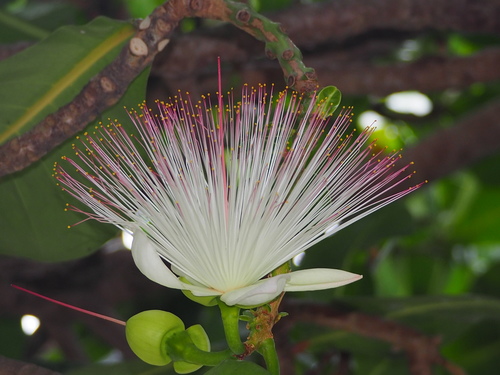
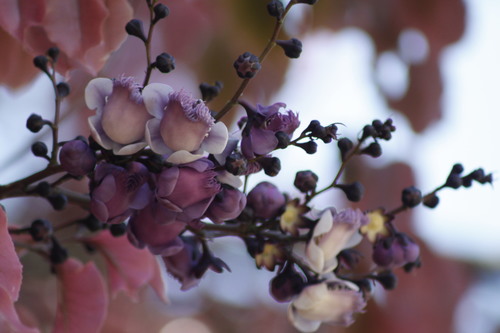
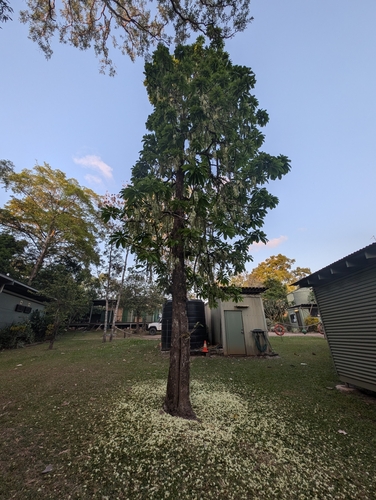
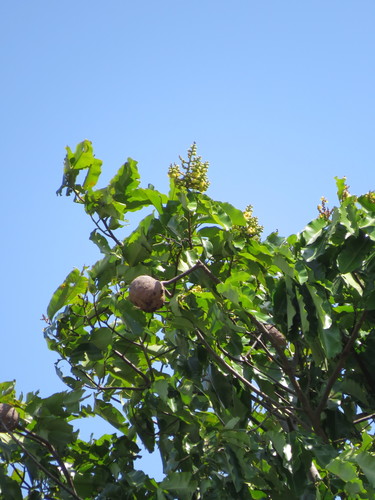
Bertholletia excelsa Bonpl., commonly known as the Brazil nut tree, is a very large tree native to South American Amazonian regions. It grows to 50 meters (160 feet) tall, with a trunk 1 to 2 meters (3 to 7 feet) in diameter, placing it among the largest trees in the Amazon rainforest. It can live 500 years or more, and often reaches 1000 years of age. Its stem is straight, and is typically branchless for well over half of the tree’s total height. It supports a large emergent crown of long branches that rises above the surrounding canopy of other forest trees. The bark is grayish and smooth. Its leaves are deciduous during the dry season, are alternately arranged, simple, and have either smooth or crenate margins. They are oblong in shape, 20–35 centimeters (8–14 inches) long and 10–15 centimeters (4–6 inches) broad. Flowers are small and greenish-white, borne in panicles 5–10 centimeters (2–4 inches) long. Each flower has a two-part deciduous calyx, six unequal cream-colored petals, and numerous stamens joined into a broad, hood-shaped structure. This species is native to the Guianas, Venezuela, Brazil, eastern Colombia, eastern Peru, and eastern Bolivia. It grows as scattered individual trees in large forests along the banks of the Amazon River, Rio Negro, Tapajós, and the Orinoco. Its fruit is heavy and rigid; when fruits fall from the tree, they pose a serious hazard to vehicles and can cause traumatic brain injury to people walking below the tree. Brazil nut trees produce fruit almost exclusively in undisturbed, pristine forests. Disturbed forests lack the large-bodied bees from the genera Bombus, Centris, Epicharis, Eulaema, and Xylocopa, which are the only pollinators capable of pollinating the tree's flowers. Different bee genera act as the primary pollinators in different regions and at different times of year. While Brazil nuts have been harvested from cultivated plantations, production is low, and plantation cultivation is currently not economically viable. After flowers are pollinated, the fruit takes 14 months to fully mature. The fruit is a large capsule 10–15 centimeters (4–6 inches) in diameter, similar in size to a coconut endocarp, and can weigh up to 2 kilograms (4 pounds 7 ounces). It has a hard, woody shell 8–12 millimeters (3/8–1/2 inch) thick, which holds eight to 24 wedge-shaped seeds 4–5 centimeters (1 5/8–2 inches) long. These seeds are the commercially known 'Brazil nuts', and are packed like orange segments, with up to three stacked whorls of seeds possible. The polar ends of seeds from the middle whorl nestle into the upper and lower whorls. The capsule has a small hole at one end, which allows large rodents such as agoutis to gnaw it open. Agoutis eat some of the seeds inside, and bury others to store for later use. Some of these buried seeds are able to germinate and grow into new Brazil nut trees. Most seeds are cached and 'planted' by agoutis during the wet season. Young saplings can stay dormant for years, waiting for an existing canopy tree to fall to allow enough sunlight to reach them before they resume growing. Capuchin monkeys have been observed opening Brazil nuts using a stone as an anvil. After Brazil nuts fall to the ground, they are susceptible to aflatoxin contamination from fungal growth. Aflatoxins can cause liver damage, including potential cancer, if consumed. Inspections have found aflatoxin levels in Brazil nuts that far exceed European Union regulatory limits. However, mechanical sorting and drying can eliminate 98% of aflatoxins, and a 2003 EU import ban on the product was lifted after new tolerance limits were established. Brazil nuts naturally contain very high concentrations of selenium. While selenium is an essential dietary trace element, it is toxic when consumed in excess. Exceeding the Tolerable Upper Intake Level of 400 micrograms per day can cause selenosis. A standard 28 gram (1 ounce) serving of Brazil nuts often exceeds this limit, so daily consumption of Brazil nuts is not recommended. The nuts may also contain trace amounts of the radioactive element radium. One kilogram of Brazil nuts holds between 40 and 260 becquerels (1 and 7 nanocuries) of radium. This radium level is low, though it is higher than the levels found in other common foods. Oak Ridge Associated Universities notes that elevated radium levels in surrounding soil do not directly lead to radium concentration in the nuts; instead, the tree's very extensive root system can concentrate naturally occurring radioactive material if it is present in the soil. Radium only accumulates in the nuts if radium is present in the growing soil. Brazil nuts also contain barium, a metal with chemical properties very similar to radium. While barium can cause toxic side effects such as weakness, vomiting, and diarrhea when ingested, the amount found in Brazil nuts is too small to cause noticeable negative health effects. Brazil nut oil is used as a lubricant for clocks, and in the manufacture of paint and cosmetics including soap and perfume. Due to its hardness, the Brazil nut shell is often pulverized and used as an abrasive to polish materials such as metals and ceramics, in the same manner as jeweler's rouge. Charcoal made from Brazil nut shells can also be used to purify water.