About Berberomeloe majalis (Linnaeus, 1758)
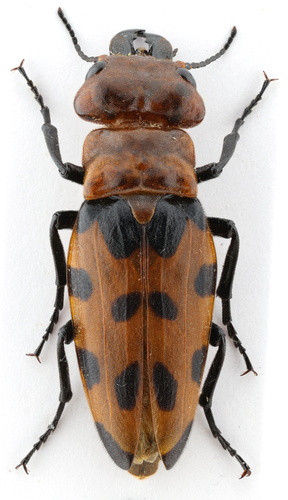
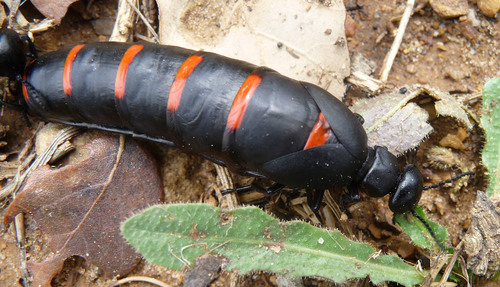
Berberomeloe majalis typically reaches a length of around 5 cm (2 in.). It is easily recognized by its large size and bright red body bands, and this coloration is aposematic. Like other oil or blister beetles in the family Meloidae, this species can squirt caustic liquid when attacked. In Spain, this beetle shows extensive color variation. Populations of fully black specimens with no red markings occur scattered across most of B. majalis’s distribution range. These all-black populations are often located near populations of red-striped specimens, but the two morphs are spatially segregated, and no mixed populations have been observed in the wild. Both entirely black and red-striped B. majalis specimens are equally poisonous. The red-striped oil beetle inhabits dry areas in Portugal, Mediterranean regions of Spain, and North Africa ranging from Morocco to Tunisia. It lives in sunny, dry environments, including open grassland and woodland with light tree cover. It can be found from sea level up to altitudes of 3000 m in the Sierra Nevada. Adult B. majalis feed on pollen. The larvae are exclusively parasitic, and primarily develop in the nests of solitary wild bees. Females lay between 2000 and 10000 eggs, but most eggs do not produce mature individuals, failing due to lack of food or predation. Compared to adults, larvae are only around 3 mm long, and their development occurs through hypermetamorphosis, meaning the different larval stages have distinct forms. Unlike the larvae of beetles in the genus Meloe, first-stage B. majalis larvae do not cling to potential hosts, and must actively seek out a host instead. After the larva consumes the host bee’s egg and the stored nectar and pollen from the bee’s nest, it leaves the nest. It then molts again, emerging with fully formed back legs. From this stage, it pupates, and emerges from the chrysalis as an adult. If a larva mistakenly targets a honey bee as a host, it will die in the hive.