About Berberis vulgaris L.
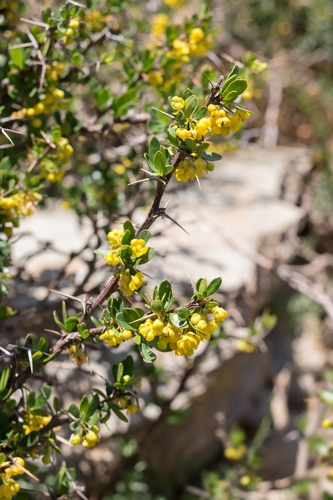
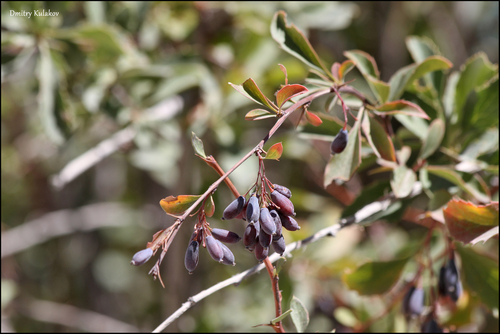
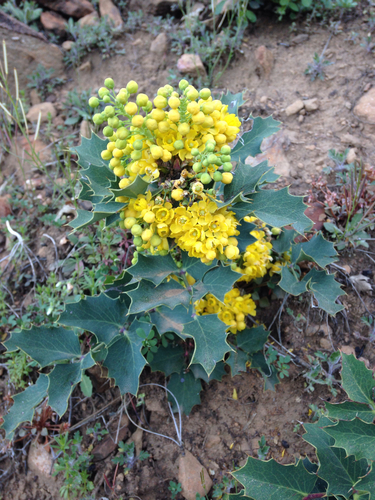
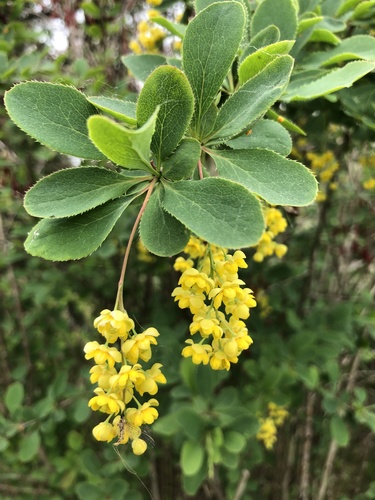
This deciduous shrub, Berberis vulgaris L., can grow up to 4 metres (13 feet) high. Its leaves are small and oval, 2–5 centimetres (3⁄4–2 inches) long and 1–2 cm (1⁄2–3⁄4 in) wide, with serrated margins. Leaves grow in clusters of 2–5, and each cluster is subtended by a three-branched spine 3–8 millimetres (1⁄8–5⁄16 in) long. The plant produces yellow flowers 4–6 mm (1⁄8–1⁄4 in) across, arranged in 3–6 cm (1+1⁄8–2+3⁄8 in) long panicles in late spring. Its fruit is an oblong red berry 7–10 mm (1⁄4–3⁄8 in) long and 3–5 mm (1⁄8–3⁄16 in) broad, which ripens in late summer or autumn. Berries persist for an average of 29.2 days, contain an average of 1.3 seeds each, and are on average 76% water by weight. By dry weight, berry tissue is 6.5% carbohydrates and 1.2% lipids.
Berberis vulgaris is native to central and southern Europe, southern England, northwest Africa, and western Asia, and is also naturalised in northern Europe and North America. In the United States and Canada, it has established wild populations ranging from Nova Scotia to Nebraska, with additional populations found in Colorado, Idaho, Washington state, Montana, and British Columbia. This species is also cultivated in many countries.
The berries of Berberis vulgaris are an important food source for many small birds, which disperse the plant's seeds through their droppings. B. vulgaris acts as the alternate host species for wheat stem rust, the fungus Puccinia graminis f. sp. tritici, a grass-infecting rust that causes a serious fungal disease in wheat and related grains. For this reason, cultivation of B. vulgaris is prohibited in Canada and parts of the United States, specifically Connecticut, Massachusetts, Michigan, and New Hampshire.
The berries are edible and rich in vitamin C, but have a very sharp sour flavour, and are not widely consumed because harvesting them from thorny shrubs is difficult. In Europe, the berries have been traditionally used as an ingredient for making jam. The berries are high in pectin, which allows jam to congeal as it cools after boiling. In southwestern Asia, especially Iran, the berries are used both for cooking and for making jam. In Iran, barberries are commonly used like currants in rice pilaf. In Persian, dried fruit of Berberis species is called زرشک (zerešk), and this term refers particularly to seedless barberry, Berberis integerrima, which is called زرشک بیدانه (zerešk bi-dâne, literally 'seedless barberry'). Seedless barberry is widely cultivated in Iran, which is the largest producer of zerešk. South Khorasan province in Iran is the main global production area for both zerešk and saffron, especially around the cities of Birjand and Qaen. Approximately 85% of Iran's zerešk production comes from Qaen, and around 15% comes from Birjand. There is recorded evidence of seedless barberry cultivation in South Khorasan dating back 200 years. In Persian, a zerešk orchard is called زرشکستان (zerešk-estân). Zerešk is widely used in cooking, where it adds a tart flavour to chicken dishes. It is commonly cooked with rice to make the dish زرشک پلو (zerešk polo), which is typically served with chicken.
Berberis vulgaris has been widely planted for hedges in New Zealand. A decoction made from the plant has been used in folk medicine to treat gastrointestinal ailments and coughs, though its use has been limited by the bitter taste of the plant's bark and root.