About Berberis thunbergii DC.
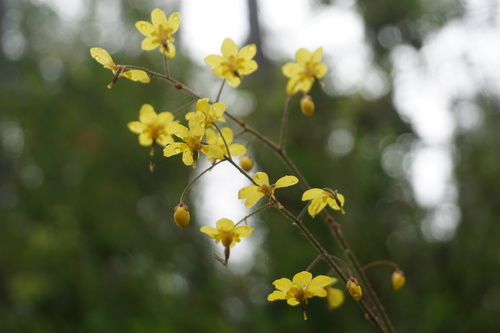
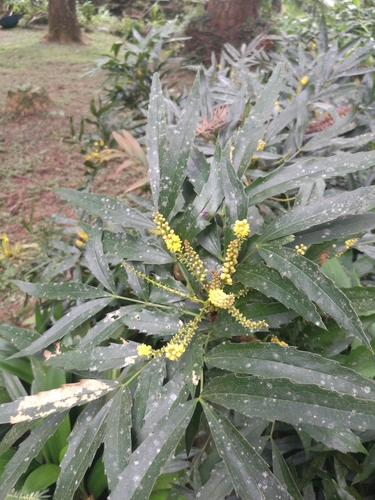
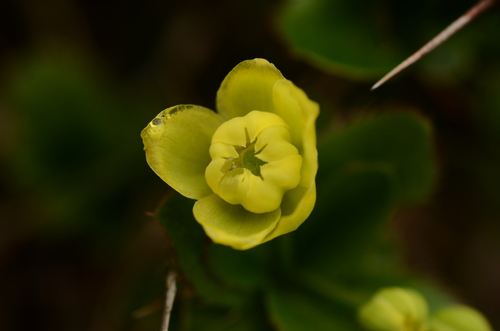
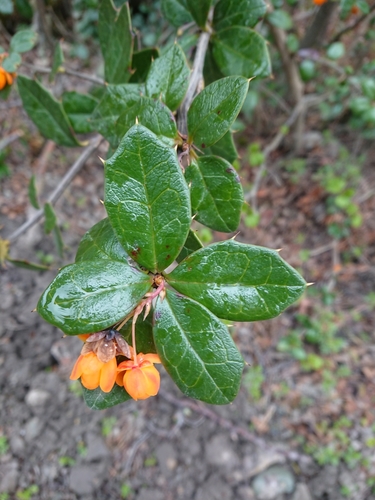
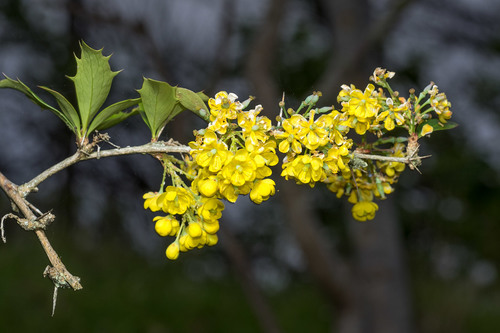
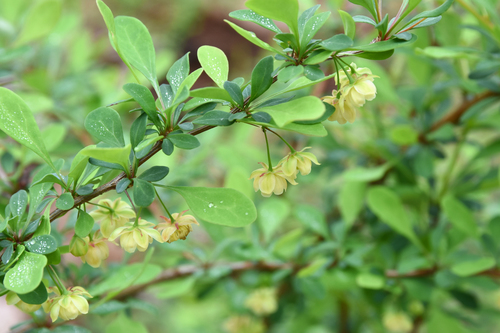
Berberis thunbergii DC. has deeply grooved, brown, spiny branches. At each shoot node, there is a single (occasionally three-pronged) spine, which is actually a highly modified leaf. Its leaves range from green to blue-green, and are reddish or purple in some horticultural variants. They are very small, shaped like spatulas to ovals, 12–24 mm (1⁄2–15⁄16 in) long and 3–15 mm (1⁄8–9⁄16 in) broad. Leaves grow in clusters of 2–6 on a dwarf shoot in the axil of each spine. The pale yellow flowers are 5–8 mm (3⁄16–5⁄16 in) in diameter, and grow in drooping, umbrella-shaped clusters 1–1.5 cm (3⁄8–5⁄8 in) long that hold 2–5 flowers each. Flowering occurs from mid-spring to early summer. The fruit is an edible, glossy, bright red to orange-red ovoid berry, 7–10 mm (9⁄32–13⁄32 in) long and 4–7 mm (5⁄32–9⁄32 in) broad, containing a single seed. Berries mature in late summer and fall, and persist through the winter. This species is sometimes confused with Berberis canadensis (American barberry), Berberis vulgaris (common or European barberry), and other deciduous Berberis species. It is most easily distinguished by its flowers growing in umbels rather than racemes. Berberis thunbergii is widely grown as an ornamental plant, both in its native Japan and elsewhere across the temperate Northern Hemisphere. Numerous cultivars have been selected for traits including yellow, dark red to violet, or variegated foliage, erect growth suitable for hedges, and dwarf size. In Brazil, the plant is popularly known as Japanese barberis, and is widely cultivated in hedges and flower beds. The following cultivars grown in cultivation in the United Kingdom have gained the Royal Horticultural Society's Award of Garden Merit: