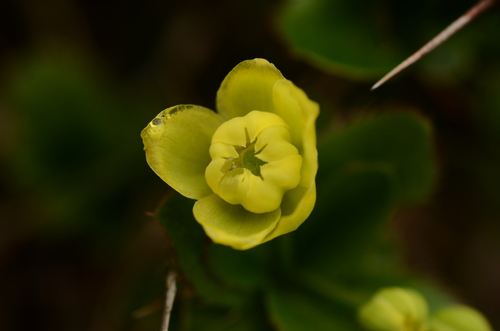
About Berberis morrisonensis Hayata
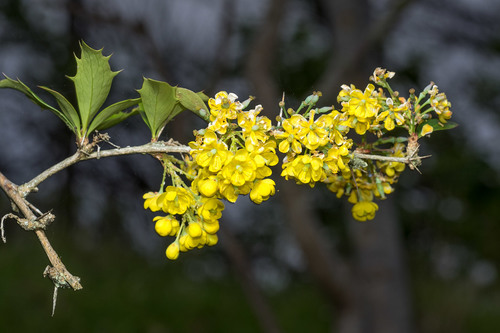
Berberis morrisonensis Hayata is a perennial deciduous shrub. It grows in open areas, forests, arrow bamboo groves, or cutover areas with good light transmission. It reaches around 1 meter in height, and bears three small thorns on its stem. It produces 8 to 10 leaves together; the leaves are papery, narrowly obovate to oblanceolate, and measure 1.5–2.5 cm long by 0.5–1 cm wide. Leaf margins have sparse sharp serrations, both sides of the leaf are the same color and hairless, though the lower half of the leaf may sometimes be pale green with prominent veins. Its yellow flowers are long elliptic, arranged in 3 to 6 clustered groups in leaf axils forming short panicles. Pedicels are 2.5–3 cm long. Outer sepals are long-ovate, about 3.5 cm long and 1.5 cm wide, while inner sepals are 6 cm long and 3 cm wide. Petals are elliptic, 5–6 cm long and 3–3.5 cm wide. There are approximately 4 to 9 ovules. Fruits are red, round spherical berries around 1 cm long. Budding occurs from late April to May, in late spring and early summer. Flowering is from June to July, fruiting from September to October. Leaves fall from November to December, and the plant enters winter dormancy. This species is found in high-altitude mountain areas above 3,000 meters in Taiwan, distributed across the Xueshan Range, Central Mountain Range, and Yushan Range, with the majority of populations occurring in the Central Mountain Range. It grows at high-altitude forest margins in Taiwan, and is a slightly shade-loving species.