About Bencomia exstipulata Svent.
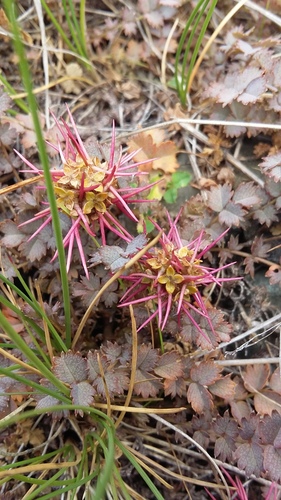
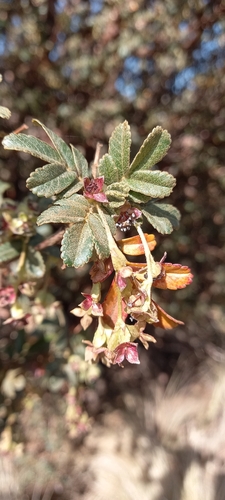
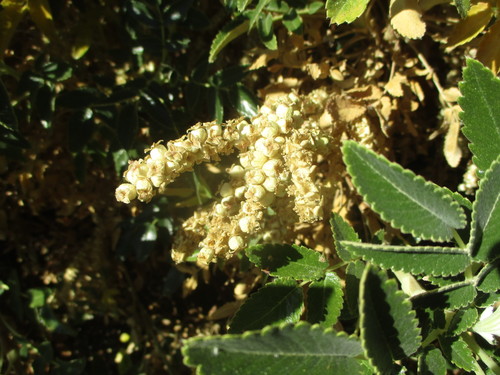
Bencomia exstipulata Svent. is a shrub that grows 50 to 100 centimeters tall. Individuals are either monoecious or unisexual female. Its branches are tortuous, and its bark is glabrous. It produces compound leaves that are pubescent and glandular. Its inflorescences are simple or racemose, and measure 4 to 8 centimeters long. The flowering period lasts from April to May. Its fruits are depressed-globose, around 5 millimeters in diameter, and the fruiting period lasts from June to July. This species is tetraploid, with a chromosome count of 2n=28. This species is endemic to the Canary Islands, where it occurs only on the islands of La Palma and Tenerife. It grows at altitudes above 1800 meters. On Tenerife, it is restricted to altitudes of 2100 to 2200 meters in the southwest of the Caldera las Cañadas del Teide. On La Palma, it occurs in Caldera de Taburiente National Park. It grows in shrub communities on rocky terrain, and is a characteristic species of the Spartocytision supranubii plant alliance. The IUCN Red List classifies this species as vulnerable, while the Canary Islands catalogue of protected species lists it as endangered. Threats to its populations include its own low reproduction rate, small total number of individuals, wildfires, and introduced species: Barbary sheep, domestic sheep, goats, and European rabbits. Pollination occurs mostly by wind, though honey bees frequently visit its flowers, so limited insect pollination likely also occurs. Some self-pollination is also assumed to take place. Seeds of this species are eaten by Gallotia galloti lizards. Seeds remain capable of germination after passing through the lizard's digestive tract, so it is thought that these lizards act as seed dispersers for the species.