About Bellatorias major (Gray, 1845)
Species Nomenclature
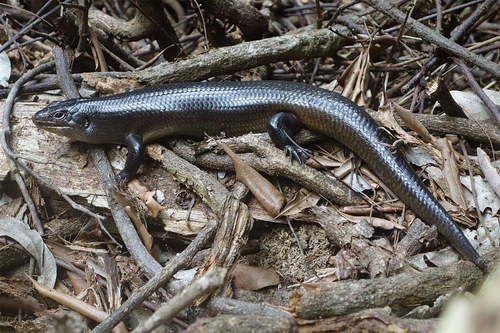
Bellatorias major (Gray, 1845), commonly called the land mullet, can reach a maximum total length of 60 cm (23.6 inches).
Dorsal Coloration
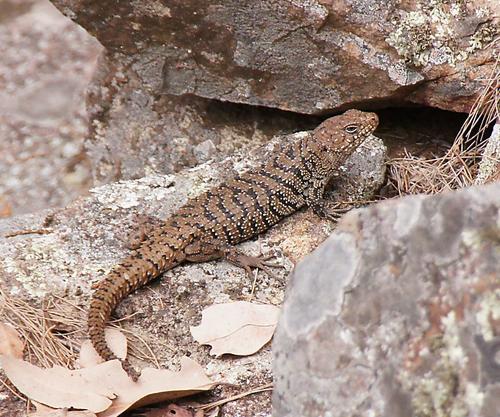
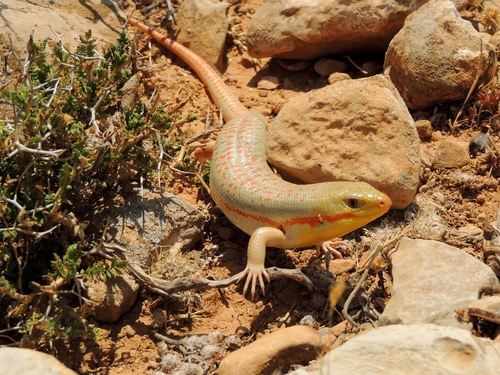
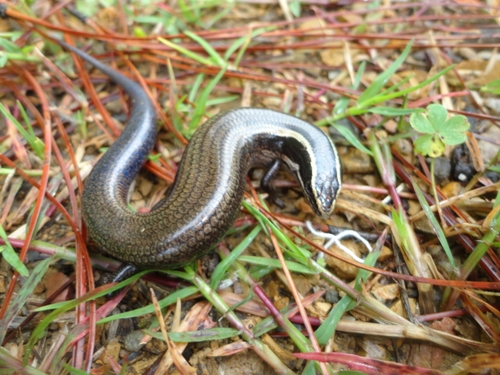
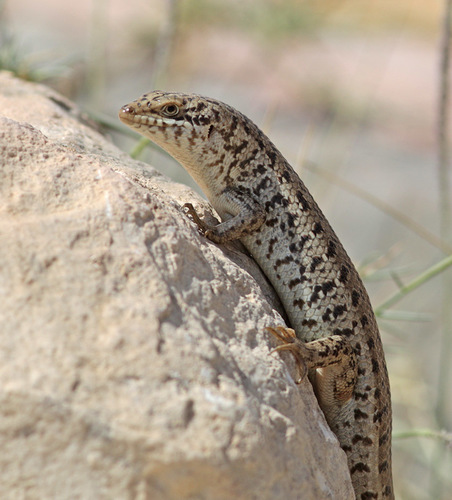
Their bodies are a uniform glossy black to brown, with a paler ring surrounding the eye.
Thermoregulation
Their dark coloration combined with their large size lets them maintain a body temperature of 30 degrees Celsius, and they spend much of the day basking in the sun.
Sexual Dimorphism
Compared to adult females, adult males have slightly shorter bodies, but slightly longer forelimbs and heads.
Ventral Coloration
The ventral (belly) side ranges in color from auburn (orange-brown) to white.
Juvenile Markings
Juveniles have prominent cream-colored spots along their sides.
Longevity
This species is long-lived; one captive female lizard is known to have lived for at least 23 years.
Common Name Origin
The common name "land mullet" is recorded as far back as Longman (1918), who noted it was already in widespread common use for this species around Tamborine Mountain. The name most likely refers to the species' superficial resemblance to the similarly named mullet fish, which shares a blunt head, large scales, and similar size and coloration.
Native Range
This species is native to Australia, and is generally restricted to rainforest habitats in south-eastern Queensland.
Distribution Extent
Its natural distribution occurs in discontinuous patches ranging from the north side of the Hawkesbury River in the south, to the Conondale Range near Maleny in south-eastern Queensland.
Altitudinal Range
It can be found at altitudes from sea level at Park Beach, New South Wales, up to 860 m at Springbrook Plateau, Queensland.
Habitat Preference
The species prefers habitats with abundant fallen logs, and stays in close proximity to these features. The limited sunlight that penetrates this forest type means suitable basking sites are a required feature of its habitat.
Non-Preferred Habitats
It is rarely found in other environment types, such as the region's open eucalypt woodland.
Shelter Behavior
These lizards take shelter in hollow logs or burrows, which are most often dug into the soil-bound root systems of fallen trees.
Reproduction
Land mullets are viviparous (live-bearing) reptiles, and typically produce between 4 to 9 independent offspring per litter.
Social Behavior
They are largely solitary, and only gather primarily to mate.