About Bedfordia salicina (Labill.) DC.
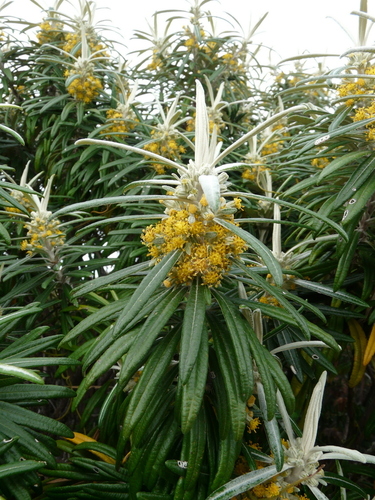
Bedfordia salicina (Labill.) DC. is a common large shrub or small tree in the Asteraceae family, reaching 2–5 m tall and 2–3 m wide. Its mostly erect central stem twists and bends, with many lateral stems branching outwards and upwards in a candelabra-like pattern. Young wood from apical meristems is covered in silvery tomentum. This species produces soft mesophyllic leaves that are alternate, borne on very short petioles up to 8 mm long. The leaves measure 60–150 mm long and 10–18 mm wide, are oblanceolate and undulate with slightly revolute margins and a prominent midrib and subtending veins. The upper adaxial leaf surface is dark green, while the lower abaxial surface is silvery, covered in a dense, matted single layer of stellate hairs. The inflorescence is an irregular panicle of 8 to 25 capitula, which grow from several upper leaf axils to form dense clusters. Each cluster holds more than five bright yellow tubular disc florets and herbaceous phyllaries. Flowering occurs from October through December. Fruits develop into achenes 3 mm long by March, and old capitula remain on the plant year-round. Bedfordia salicina is endemic to Tasmania, and is most common in the island’s eastern and central regions. It grows in the shrubby understorey of dry to wet sclerophyll forests and woodlands. It is most commonly found on highly fertile Jurassic Dolerite soils, but can also grow on a range of other rock types, occurring from sea level up to 1,000 m elevation. In dry sclerophyll forests, it is often associated with Eucalyptus obliqua, Eucalyptus delegatensis, Eucalyptus globulus, Eucalyptus pulchella, Pomaderris apetala, Acacia dealbata, Acacia mucronata, Leptospermum lanigerum, Bursaria spinosa, Dodonaea viscosa, Olearia viscosa, Cyathodes glauca, Blechnum wattsii and Blechnum nudum. It also grows in the low-diversity, variably dense shrub layer dominated by Xanthorrhoea australis in Callitris-dominated woodland that contains 10 m tall Eucalyptus globulus and Eucalyptus viminalis. These woodlands occur in fire shadow sites, on dry rocky dolerite substrate, or on boulder-strewn shores with sandstone talus and slope deposits in south-east Tasmania. Bedfordia salicina can also be found along the high energy coastline near Port Arthur, growing alongside tussock grassland, heath and scrub on mudstone cliffs. In wet sclerophyll forests where this species occurs, the canopy is typically dominated by Eucalyptus obliqua and Eucalyptus regnans, with an understory containing Acacia melanoxylon and Acacia dealbata, and other shrubs of similar height to Bedfordia salicina including Olearia argophylla, Nematolepis squamea, Pomaderris apetala, Pittosporum bicolor and Coprosma quadrifida. Bedfordia salicina occurs in sclerophyllous forests that are broadly adapted to periodic fire. Wetter forest environments have fire-free intervals of up to 100 years, while drier environments have fire-free intervals of 25 to 50 years. The species has a low tendency to carry fire among wet sclerophyll and gully species, and requires considerable moisture loss before flaming can occur. When oven-dried, Bedfordia salicina loses 65–72% of its initial weight as moisture, and at this moisture content it can both ignite and spread fire rapidly. After fire, Bedfordia salicina can regenerate either vegetatively from lignotubers or from seed. Bedfordia salicina experiences heavy browsing by macropods, particularly when supplies of the macropods’ preferred species, Exocarpus cupressiformis and Bursaria spinosa, are absent or exhausted. Several natural terpenoids are found in Bedfordia salicina, including sesquiterpenoids, diterpenoids, and cinnamate ester compounds.