About Bauhinia variegata L.
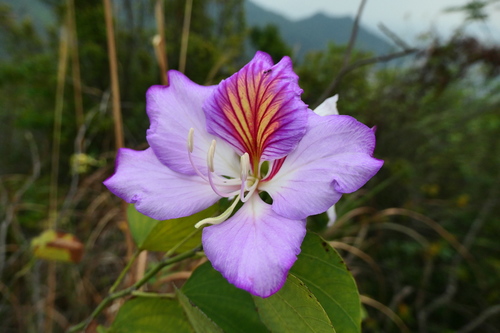
Bauhinia variegata L. is a small to medium-sized dry-season deciduous tree that reaches 15 metres (49 ft) tall and up to 50 centimetres (20 in) in trunk diameter. Its leaves are obcordate, bilobed at both the base and apex, and measure 15–20 centimetres (5.9–7.9 in) in both length and width. The tree produces conspicuous flowers that are bright pink or white, 5–7 centimetres (2.0–2.8 in) in diameter, with five petals. Its pollen grains are elongated, approximately 75 microns long. After flowering, it develops dry seedpods 20–30 centimetres (7.9–11.8 in) long, each holding 10–15 seeds. The seedpod dries completely while attached to the tree; when mature, it twists into a corkscrew or helical shape, then explodes open with an audible clack to release its seeds into the surrounding area.
Transverse section anatomical studies of the tree's stem show distinct periderm and cortex tissue. The secondary phloem forms a wide, continuous cylinder that contains thin, narrow straight rays, three or four discontinuous masses of fibres, and randomly distributed sieve elements. The secondary xylem is diffuse porous, and is made up of vessels, fibres, xylem rays, and xylem parenchyma. Xylem fibres mostly have thick lignified walls, though some have gelatinous walls. Xylem parenchyma cells are abundant throughout the xylem. Xylem rays are only one cell wide, straight, and consist of radially elongated cells with thick, lignified walls. Calcium oxalate crystals in the stem are predominantly prismatic crystals or druses. Powder microscopical examination of stem tissue confirms the presence of fibres, parenchymatous cells, periderm, and vessel elements. Histochemical analysis of the stem detects the presence of protein, tannin, lignin, and cellulose.
Transverse section anatomical studies of the root show distinct secondary phloem and secondary xylem tissue. The secondary phloem has fairly wide rays, dense masses of phloem fibers, and radial rows of phloem elements. The secondary xylem contains much wider, thin-walled vessels that occur either singly or in radial multiples. Xylem fibres include both gelatinous and normal types. Calcium oxalate crystals in the root are predominantly prismatic type. Powder microscopical examination of root tissue detects the presence of xylem parenchyma cells, xylem fibres, and vessel elements.
Bauhinia variegata is a diploid species with 28 chromosomes. Sequencing of its 314MB genome has confirmed that it is the paternal ancestor of the hybrid Hong Kong Bauhinia (Bauhinia × blakeana).
In cultivation, B. variegata is a very popular ornamental tree grown in subtropical and tropical climates, valued for its scented flowers. It is also used as a food source in many South Asian cuisines. In the Neotropics, it is planted in gardens and parks to attract hummingbird species including the sapphire-spangled emerald (Amazilia lactea), glittering-bellied emerald (Chlorostilbon lucidus), and white-throated hummingbird (Leucochloris albicollis). In some regions, it has become naturalized and invasive.
In the Indian subcontinent, B. variegata is known by local common names including Kachnar, Kovidara, Koiralo, and Kanchan. Its edible buds are widely used as an ingredient in many regional recipes. The traditional dish kachnar curry is prepared with these buds, combined with yogurt, onions, and local spices. The buds are also eaten as a stir-fried vegetable and used to make achaar, a regional pickle. The species has been found to exhibit good antioxidant and anticancer activity. It is considered a sacred tree in Hinduism, where it is called Kovidara and is symbolically featured on the Dharma Dhwaja flag. In Nepal, the plant is called koiralo, and its flower is called koiralo ko phool in Nepali. Nepalese cuisine uses the tree's flowers and buds to make a style of achaar, which is an important part of the meal served during the Ghode Jatra festival.