About Bauhinia purpurea L.
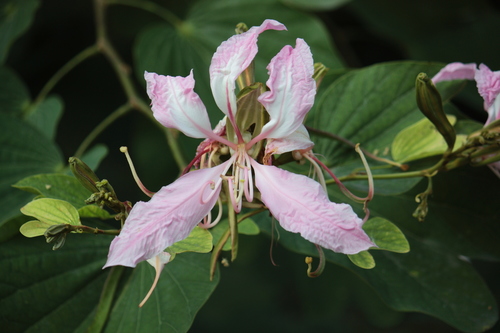
Bauhinia purpurea L. is a small to medium-sized deciduous tree that reaches 5.2 metres (17 ft) in height. Its leaves are alternate, 10 to 20 centimetres (4 to 8 in) long and broad, rounded, and bilobed at both the base and apex. The species produces large, noticeable pink fragrant flowers that have five petals. Its fruit is a pod 30 cm (12 in) long, which holds 12 to 16 seeds. This is a diploid species with 28 chromosomes. Sequencing of its 304MB genome confirmed that it is the maternal ancestor of the hybrid Hong Kong Bauhinia (Bauhinia x blakeana). The hybrid Hong Kong Bauhinia is typically propagated by grafting onto stems of B. purpurea.
B. purpurea is native to the Indian subcontinent and Myanmar, and has been widely introduced to other tropical and subtropical regions across the globe. In the United States, it grows in Hawaii, coastal California, southern Texas, and southwest Florida.
The young leaves and flowers of B. purpurea are edible. In the Philippines, this species is called alibangbang, which literally means "butterfly". Its leaves have a citrusy, sour taste, and are used in Philippine cuisine as a souring agent for sinigang and similar dishes, or as a pickled condiment. Across Southeast Asia, B. purpurea and related species are used to make poultices that treat swelling, bruises, boils, and ulcers. Different parts of the plant are also prepared as decoctions to treat fever and stomach problems, and are used as an astringent. In Indian traditional medicine, the leaves are used to treat coughs, while the bark is used to treat glandular diseases and works as an antidote for poisons. Its flowers are added to pickles and curries, and are considered to have laxative effects.