About Battarrea phalloides (Dicks.) Pers.
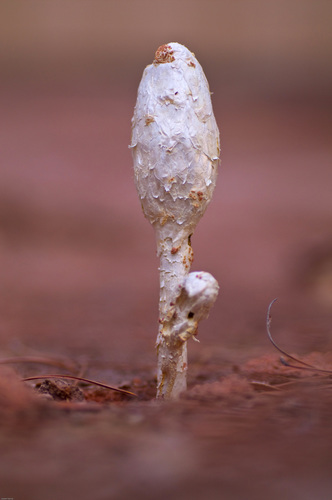
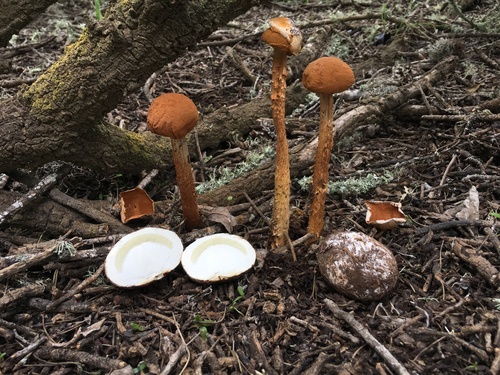
Mature specimens of Battarrea phalloides roughly resemble the typical stem-and-cap structure of agaric mushrooms, but instead of a gilled cap, this species has a spore sac positioned atop the stem. Young fruit bodies are roughly spherical and fully enclosed in an outer wall called the exoperidium. The exoperidium later splits along a circular, equatorial line in a process called circumscission. The lower section of the split wall forms a volva, while the upper section forms scales that cover the inner wall. The upper part rolls upward and backward before eventually falling away as a single piece, exposing a spore sac lined with a narrow ring of capillitium and spores. The spores are sticky. As wind carries spores away, the drying effect of wind causes the edges of the peridium to shrivel and roll up further, exposing more spores. This process continues until the upper half of the peridium has shriveled and blown away, leaving only a small number of spores that may later be washed away by rain.
Fruit bodies of Battarrea phalloides develop rapidly. When mature, they are rust-colored, with a hemispherical to somewhat conical "head" 1 to 3 cm (0.4 to 1.2 in) in diameter, and a stalk up to 40 cm (15.7 in) long by 0.4 to 1.5 cm (0.2 to 0.6 in) thick. One study documented a specimen found in Mexico that measured 70 cm (27.6 in) in length. Typically, the spore case is 3 to 5 cm (1.2 to 2.0 in) broad by 1 to 3.5 cm (0.4 to 1.4 in) tall. The hollow stalk is pale brown to brown, woody in texture, and has a fibrous, scaly, or even woolly surface. The mature gleba, which is fully exposed once the peridial cap is shed, is rust-brown in color. The cap may remain after the spore mass is dispersed, forming a disc-like structure that slides down the stalk like a ring. The fragile, sac-shaped volva grows up to 15 by 13 cm (5.9 by 5.1 in) broad, is unattached to the stalk, and is formed from two distinct, separated tissue layers. The inner layer matches the texture of the stem scales, and consists of hyphae 3–18 μm in diameter, which are closely arranged (nearly parallel), septate, sparsely branched, yellowish ochre, with clamps at some septa. The outer layer of fungal tissue is thicker, membranous, sometimes has a corky texture when dry, and is dirty white. It is made up of pale yellow intertwined hyphae that are difficult to tell apart individually, and contains no remaining gelatinous matrix. Dried fruit bodies can persist for several months. Thick-walled spores are roughly spherical, rusty-brown, finely and densely warted, and measure 5–6.5 μm in diameter. Elaters are 50–80 by 4–6 μm, and have ring-like or spiral thickenings. The endoperidium is made of densely interwoven hyphae 3–9 μm in diameter with walls less than 1 μm thick; these hyphae are septate, branched, pale yellow, and have clamp connections. The gleba is largely composed of two types of threads. The pseudocapillitium has hyphae up to 5 μm in diameter, mostly thin-walled, smooth, septate, sparsely branched, hyaline to pale yellow, with clamps. The elaters have diameters of 3.5–7 μm and are 32–70 μm long; they are pale yellow, smooth-walled, tapered, and cylindrical with spiral thickenings. Glebal elaters are aseptate and unbranched.
In terms of habitat and distribution, Battarrea phalloides grows solitary to scattered on dry, sandy hedgebanks (raised mounded boundary features, often topped by a hedgerow), and sometimes grows among elm suckers. It is a relatively rare species, but may be locally abundant in some sites. In Mexico, where it is only known from the northern and central regions of the country, it is most often collected in arid and semiarid areas on coastal dunes, ranging from sea level up to 2,550 m (8,370 ft) in elevation. This mushroom has been found growing near Schinus molle (a quick-growing evergreen tree), as well as Lycium brevipes, Solanum hindsianum, Salicornia subterminalis, Atriplex linearis, Quercus agrifolia and Opuntia species, in coastal dunes. The largest fruit bodies have been found on floodplains with halophilic (high-salt-tolerant) vegetation. In Belgium, specimens have been found on sandy soil under dead elderflower bushes. In North America, B. phalloides has been collected from Yukon Territory in western Canada; the United States, where it is restricted to the west (Southern California, New Mexico, and Arizona); Mexico; and Hawaii. It has also been reported from South America (Brazil), Africa (Morocco), Europe (Belgium and North Macedonia), China, Australia, and Aotearoa New Zealand. Due to a decline in sightings, B. phalloides received legal protection in Hungary in 2005, making picking it a finable offense. It gained similar protected status in the United Kingdom in 1998. Battarrea stevenii, a related species, occurs in arid regions of the western and southwestern United States, Australia, Aotearoa New Zealand, South Africa, and several European countries including Russia.