About Bassia hyssopifolia (Pall.) Kuntze
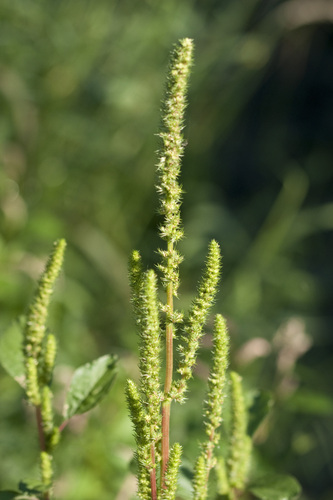
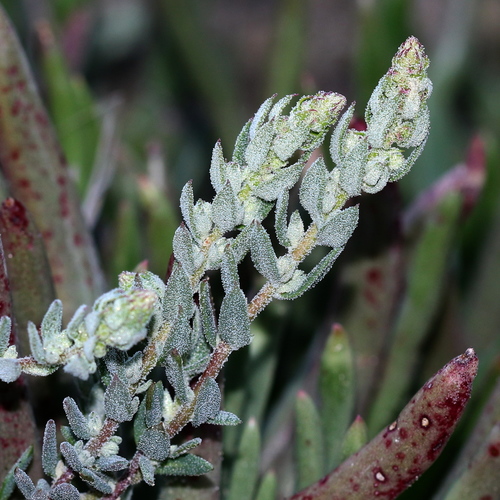
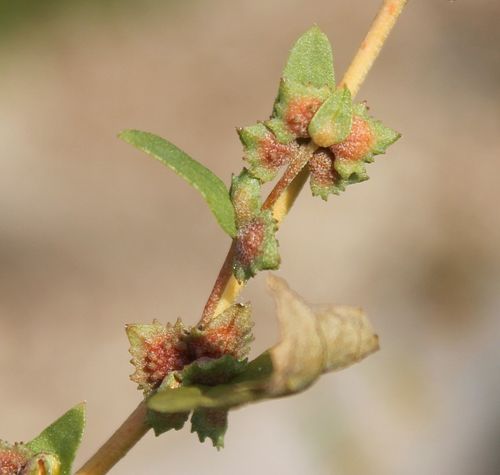
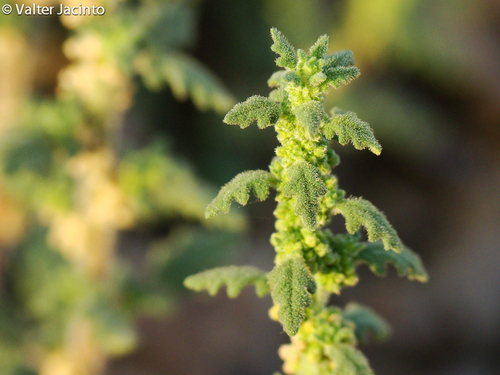
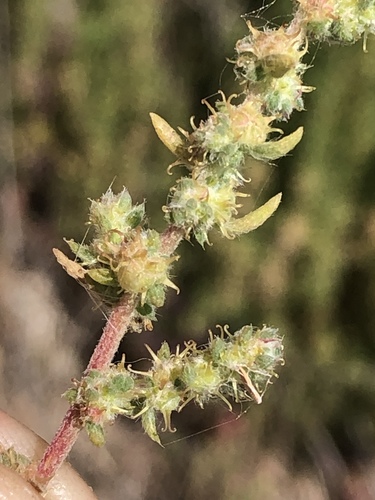
Bassia hyssopifolia (Pall.) Kuntze is an annual herb with simple or branching stems that usually grow up to 1 metre tall, and occasionally reach greater heights. Its leaf blades are flat, ranging from linear to lance-shaped. The lowest leaves on the plant grow up to 6 centimetres long. The inflorescence is a short, narrow spike that grows on the upper section of the stem, lined with woolly-haired flowers that grow singly, in pairs, or in clusters of three. The small flower has five segments, each of which develops a hooked spine when mature. The fruit is less than 2 millimetres long, and the hooked spines from the flower remain attached to the dry fruit. This species resembles kochia (Bassia scoparia), but has longer, hairier flower spikes. It has been confused with Russian thistle (Kali tragus), but is less branched and less spiny. It is also similar to lamb's quarters (Chenopodium album), but its leaves are smaller and narrow to a pointed tip. This plant is native to Eurasia, and was first described from the Caspian Sea region. It may have spread outside its native range as a seed contaminant, most likely of alfalfa seed. It was first recorded in North America in 1915 near Fallon, Nevada. By 1921, it was found in the Central Valley of California, and by 1940, it occurred from British Columbia to Wyoming and had become established in eastern North America. Seeds are most likely dispersed when the spiny dry fruits catch on animal fur and feathers, and human activities like road maintenance may help the seeds spread and become established.