About Bassaricyon gabbii J.A.Allen, 1876
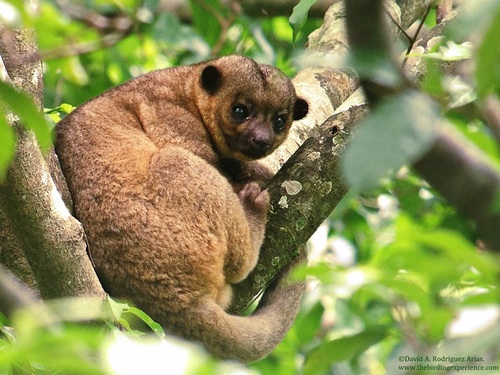
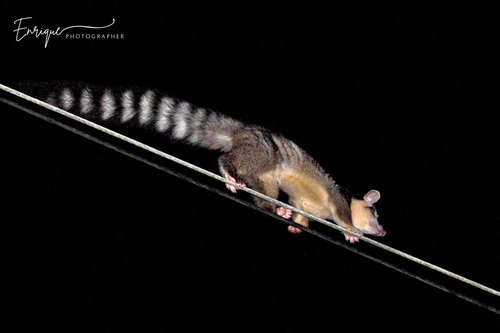
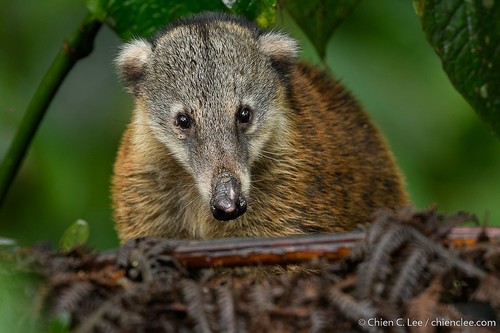
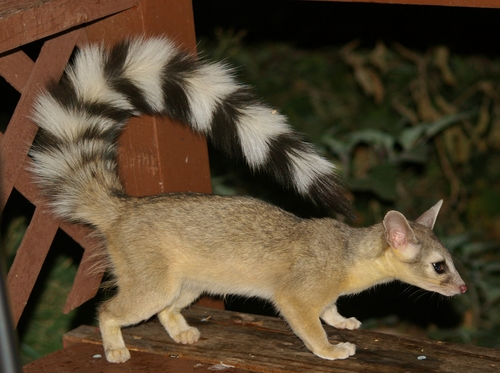
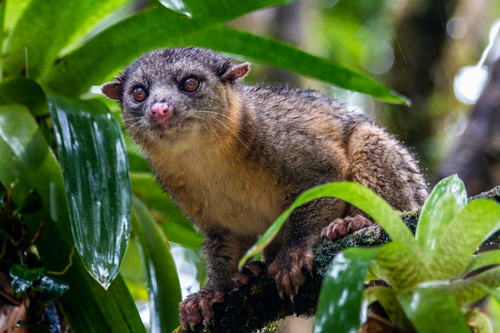
Description: The northern olingo (Bassaricyon gabbii J.A.Allen, 1876) is a slender arboreal mammal. Its hind legs are distinctly longer than its fore legs, and it has a long, bushy tail. The species has a short, rounded face with relatively large eyes and short round ears. Its fur is thick, and is brown or grey-brown across most of the body, becoming slightly darker along the middle of the back, while the underparts range from light cream to yellowish. A band of yellowish fur runs around the throat and sides of the head, extending to the base of the ears, and the face itself is covered in greyish fur. The tail matches the body in color, but has several faint rings of darker fur along its length. The soles of the northern olingo's feet are hairy, its toes are slightly flattened, and each toe ends in a short, curved claw. Females have a single pair of teats, positioned on the rear part of the abdomen near the hind legs. Adult northern olingos measure 36 to 42 centimetres (14 to 17 in) from head to body, with a tail that is 38 to 48 centimetres (15 to 19 in) long. They weigh between approximately 1.2 to 1.4 kilograms (2.6 to 3.1 lb). The northern olingo has a pair of anal scent glands that produce a foul-smelling chemical when the animal is alarmed. It is the largest of all olingo species. Its fur is typically less reddish-brown (rufous) than that of other olingos, and its tail rings are slightly more distinct. Distribution and habitat: The northern olingo is found from Nicaragua south through Colombia, where it has been recorded as far south as El Carmen de Atrato, Chocó Department, and also occurs throughout Costa Rica and Panama. It has been occasionally reported from Honduras and Guatemala, but these reports are considered dubious because the species closely resembles the more common kinkajou. The species is not currently recognized by the IUCN. While some individuals have been found at elevations as low as sea level, it typically lives in montane and tropical moist forests from 1,000 metres (3,300 ft) up to around 2,000 metres (6,600 ft) elevation. It appears to avoid human-disturbed areas, plantations, and secondary forest.