About Basileuterus rufifrons (Swainson, 1838)
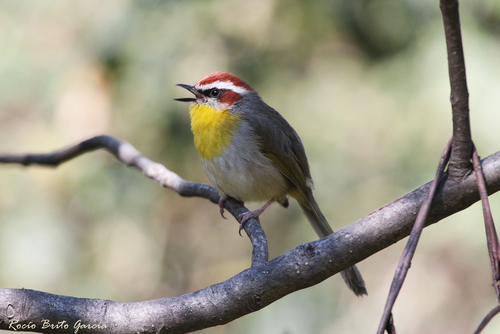
The rufous-capped warbler, scientifically named Basileuterus rufifrons, is a species of New World warbler. It is native to the region from Mexico south to Guatemala, and rarely occurs as far north as southeastern Arizona and south Texas. Birds that once were part of this species' southern range are now recognized as a separate species, the chestnut-capped warbler (Basileuterus delattrii). Adult rufous-capped warblers typically grow to around 12.7 cm (5.0 in) in length. Their upperparts are plain olive to olive-gray, they have white underbellies, and bright yellow chests and throats. They have a distinctive facial pattern marked by a rufous cap, a white eyebrow stripe (also called a superciliary), a dark eye-line that fades into a rufous cheek, and a white malar marking. Compared to other warblers, their bill is quite stout, their wings are round and stubby, and their tail is long, often held at a high angle and flicked. While rufous-capped warblers generally inhabit tropical shrubby highlands, sightings of the species in North America usually occur in oak woodland canyon bottoms close to running water, where the birds stay low in dense vegetation. The courtship song of the rufous-capped warbler is a rapid, accelerating sequence of chipping notes (described as chit-chit-chit-chitchitchit) that is somewhat similar to the song of the rufous-crowned sparrow. Its call note is a hard chik or tsik, which is often repeated. Like other New World warblers, this species does not actually produce warbling songs. Male rufous-capped warblers have complex songs, with many syllable types shared both within the song repertoire of a single male and between the repertoires of different males. Males also show seasonal, temporal, and annual variation in how they use their songs. Rufous-capped warblers feed primarily on insects and spiders. They forage by moving through dense brush and scanning close to the ground for moving prey, and are not generally known to catch insects by flycatching from perches.