About Basileuterus melanogenys S.F.Baird, 1865
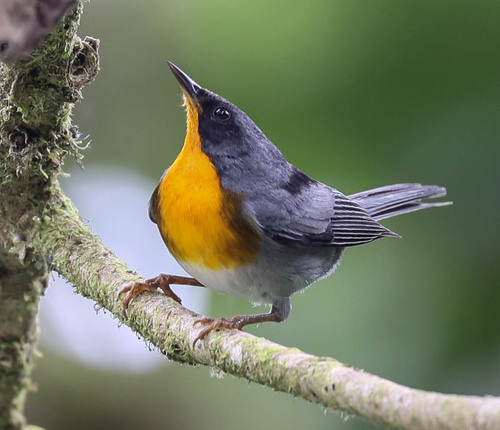
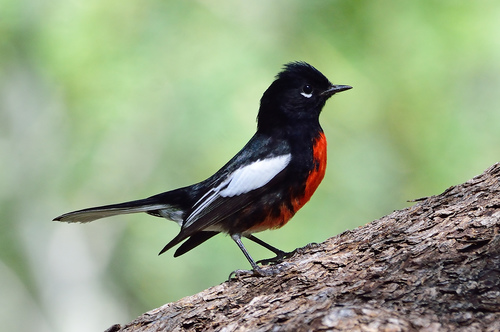
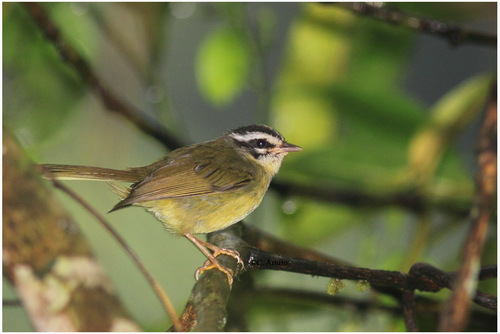
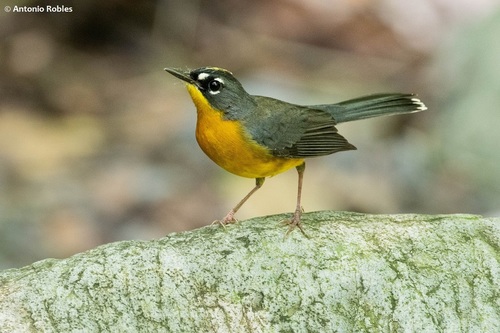
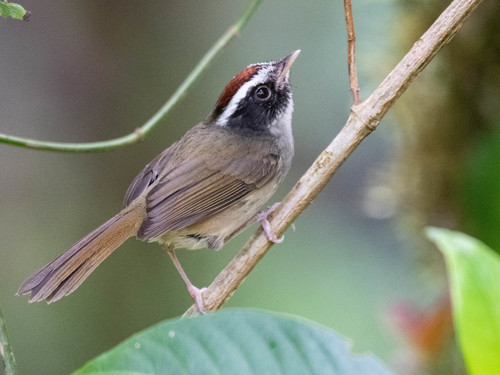
The black-cheeked warbler, with the scientific name Basileuterus melanogenys, is a New World warbler. It is a resident breeding bird endemic to the Talamancan montane forests of Costa Rica and western Panama. It typically occurs in oak forests with dense bamboo understory at altitudes ranging from 2500 m up to the timberline, and occasionally can be found as low as 1600 m. A breeding pair of this species builds a bulky domed nest with a side entrance, placed on a sloping bank or in a gully. The female lays two white eggs. The black-cheeked warbler measures 13–13.5 cm in length and weighs 13 g. It has a rufous crown, long white supercilia, and black cheeks. Its upperparts are dull olive, its breast is olive-grey, and its belly is yellow-white. The sexes have similar appearance. Young birds are browner on the upperparts, have a dull supercilium, a greyer breast, and display two cinnamon wingbars. Despite the species' restricted range, it is divided into three subspecies. The nominate subspecies, B. m. melanogenys, which matches the description above, breeds in central and southern Costa Rica. B. m. eximius is highly restricted to a small area of western Panama, and has a slightly whiter belly than B. m. melanogenys. B. m. bensoni is highly restricted to a small area of west-central Panama; it is whiter on its underparts than eximius, and has a purer grey on its upperparts. The black-cheeked warbler feeds mainly on insects, spiders, and other small invertebrates, which it captures low in the undergrowth. Its call note is a hard tsit, and the male's song is a lisping, spluttered sequence: tsi tsi wee tsi tsi wu tsi wee.