About Basileuterus lachrymosus (Bonaparte, 1850)
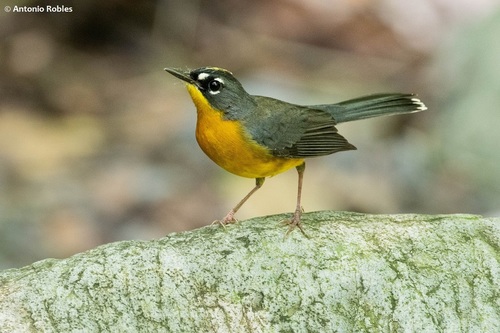
The fan-tailed warbler, scientifically named Basileuterus lachrymosus, is a species of New World warbler in the genus Basileuterus. Its natural breeding range runs along the Pacific slope from northern Mexico to Nicaragua, with vagrant records documented in Arizona, New Mexico, and Texas. This species measures 14.5 to 16 cm (5.8 to 6.3 inches) in length. Its throat and underparts are yellow, with a soft tawny tint across its chest. The head is gray, with a yellow crown bordered by black and white feathering surrounding the eyes; its undertail coverts are also white. It produces a pleasant, upslurred song. Fan-tailed warblers inhabit evergreen and semideciduous forest interiors and edges, particularly near ravines. They feed on insects, foraging by hopping on or close to the forest floor, and are typically found alone or in pairs. This species practices commensal feeding, opportunistically catching prey that has been disturbed by the foraging or hunting of other animals. It has been observed following and foraging near army ants, other passerine birds, and nine-banded armadillos. Due to its distinct morphology, the fan-tailed warbler was formerly classified in its own separate monotypic genus, Euthlypis. However, details of its nest, eggs, song, and juvenile plumage align with species of the genus Basileuterus. A 2010 molecular phylogenetic study found the fan-tailed warbler to be a basal lineage of all other species in the genus Basileuterus, while a 2024 molecular phylogenetic study instead found it to be the sister species to a clade containing the genera Myioborus, Cardellina, and all other currently accepted Basileuterus species.