About Bartsia alpina L.
Species Identity and Growth Form
Bartsia alpina L. is a hemiparasitic perennial plant with a woody rhizome, growing between 8 and 30 cm (3 and 12 in) tall.
Stem Characteristics
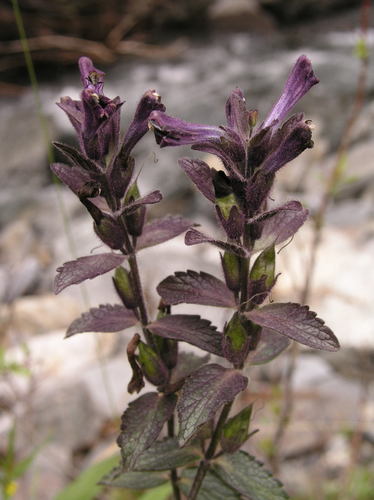
Its stem is erect, sometimes branched, hairy, and purple in color.
Leaf Arrangement and Shape
Its leaves grow in opposite pairs, with oval leaf blades reaching up to 25 mm (1.0 in) long and toothed margins.
Leaf Coloration
Leaves at the base of the plant are green, while leaves growing higher up the stem are tinged with purple.
Corolla Size
The dark purple corolla is about 20 mm (0.8 in) long.
Corolla Structure
It is narrow at the base and has two lips: an obtuse upper lip and a smaller lower lip with three blunt, equal-sized lobes.
Reproductive Organ Structure
Four stamens are fused to the corolla, and two ovaries are fused to the style.
Fruit Characteristics
The fruit is an oval brown capsule.
General Distribution Range
Bartsia alpina has a European Arctic-montane distribution, and is also found in North America.
Eurasian Distribution
It grows in mountainous regions of northern Russia, Finland, Norway, and Sweden, as well as in the Alps and other Central European mountain ranges, extending as far south as the Pyrenees and southwestern Bulgaria.
North Atlantic and North American Distribution
It also occurs in Iceland, Greenland, and northeastern Canada.
British Isles Distribution
In the British Isles, it has a very restricted distribution, only growing in a small number of upland locations in northern England and the central Scottish Highlands.
Historical Habitat and Threats
Historically, it grew in damp pasture, basic flushes and runnels, and wet, steep, species-rich banks, but overgrazing and trampling by livestock have largely eliminated it from these habitats.
Current Persistent Habitat
It has persisted better in ledge communities on mica-schist crags, where it is not exposed to grazing animals.