About Bartonia virginica (L.) Britton, Sterns & Poggenb.
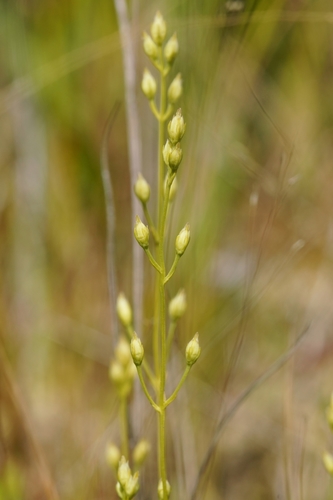
Bartonia virginica (L.) Britton, Sterns & Poggenb. is an annual plant that typically grows with wiry, erect, simple stems. Stems reach 1–4 dm in height and bear opposite, strongly ascending branches. Its leaves are scale-like and usually arranged oppositely. Flowers are organized into racemose or paniculate inflorescences, which commonly have opposite, very upright branches and pedicels. Each individual flower is 3–4 mm long, with lance-subulate shaped sepals. Petals are oblong, usually have denticulate margins, and are abruptly narrowed to a rounded or obtuse, often mucronate tip. Anthers are minutely apiculate. This species flowers in late summer, and has a diploid (2n) chromosome count of 52. This plant grows in sphagnum bogs and wet meadows, most commonly in acid bogs that contain sphagnum or Polytrichum mosses. It is native to eastern North America, with a native distribution centered on the Atlantic coastal plain and scattered inland populations. Its range extends from Quebec and Nova Scotia in Canada, south through the United States to Florida and Louisiana, reaching west to Wisconsin. The westernmost edge of its range is eastern Minnesota, where it is very rare and listed as endangered. In Minnesota, it has been recorded in Goodhue and Anoka counties, growing in white cedar swamps and peat bogs.