About Bartheletia paradoxa G.Arnaud ex Scheuer, R.Bauer, M.Lutz, Stabenth., Melnik & Grube
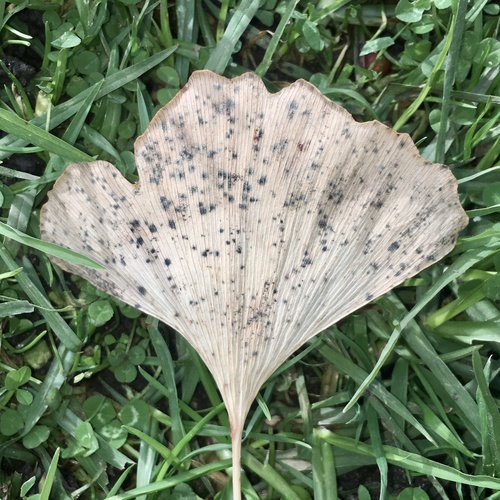
Bartheletia paradoxa G.Arnaud ex Scheuer, R.Bauer, M.Lutz, Stabenth., Melnik & Grube is a species of dimorphic fungus, and it is the only member of the genus Bartheletia. Bartheletia is the only genus in the family Bartheletiaceae; Bartheletiaceae is the only family in the order Bartheletiales, and Bartheletiales is the only order in the class Bartheletiomycetes. Sorus-like sporodochia develop on freshly fallen leaves and petioles of Ginkgo biloba during early autumn in Asia and Europe, and these structures persist through the winter. The sporodochia produce slimy, transparent, single-celled, cylindrical conidia. Thick-walled, dark brown teliospores develop inside leaf tissue, clustered in structures that are around 1 mm in diameter. These structures are similar to the telia of rust fungi, and they cause black leaf spots that are surrounded by a gray halo. After one year of dormancy, long-stalked basidia emerge from each teliospore through an apical channel. The basidia become round and cruciately-septate, and produce a sequence of cylindrical basidiospores from four wart-like growth points. Cultures of this fungus can be isolated by spreading discharged basidiospores or conidia on standard agar media. Just like its host Ginkgo biloba, B. paradoxa has no close living relatives, and it is classified as a "living fossil".

