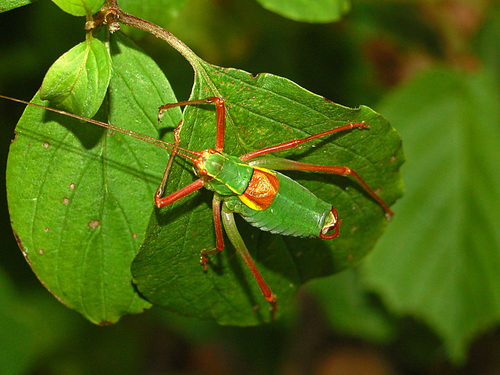
About Barbitistes obtusus Targioni-Tozzetti, 1881
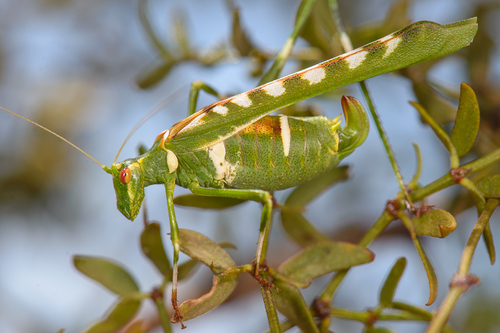
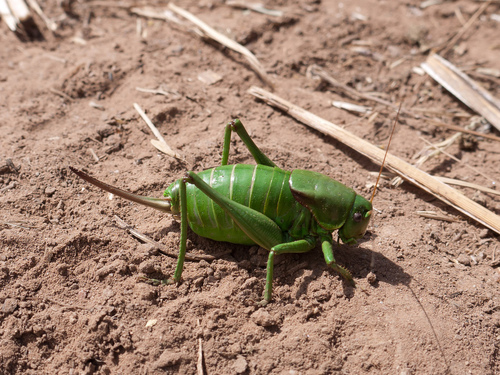
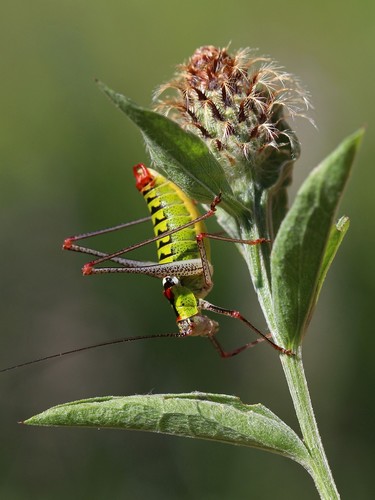
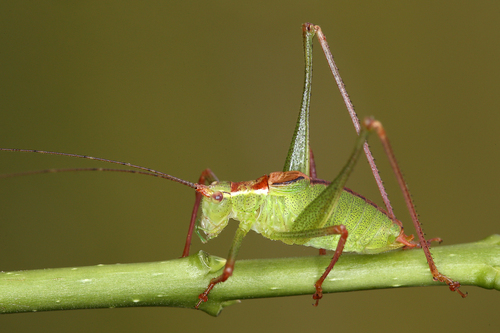
Barbitistes obtusus reaches a body length of 18–20 millimetres (0.71–0.79 in) in males, and 20–21 millimetres (0.79–0.83 in) in females, with an ovipositor measuring 9–10 millimetres (0.35–0.39 in). This species is very similar to Barbitistes serricauda, making the two hard to tell apart. Its base body color varies widely, ranging from gray and light brown to olive green and turquoise; dark-colored individuals are rare. The head is reddish. The antennae are reddish to dark, roughly the same length as the body, and have a small bright ring at regular intervals. Two yellow stripes with red borders run from the eyes across the pronotum and tegmina. The abdomen is short and thick, while the pronotum and head are quite small, and the abdomen bears tiny dark spots. The reddish legs are medium length and have small spines. The distinctly shaped wings are reddish-brown with a yellow line along the lateral edge. Female wings are shorter, and may be greenish, yellowish, or reddish brown. The male cerci are dark red-brown, clearly S-shaped, and have a rounded apex; this feature is the most important characteristic used to distinguish this species from Barbitistes serricauda. In terms of distribution and habitat, this species replaces Barbitistes serricauda in the Southern Alps. It is found in France, Italy, and Switzerland, ranging from the Basses-Alpes to the Julian Alps and central Apennines, with small populations in the Apuan Alps. This typical mountain species prefers lightly shaded woods and scrubland up to 2000 meters above sea level, and it is often found on blackberry leaves.