About Barbarea vulgaris (L.) W.T.Aiton
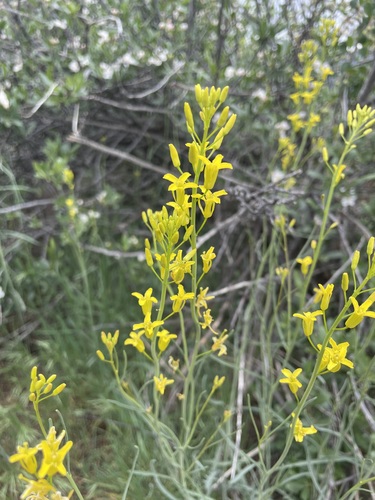
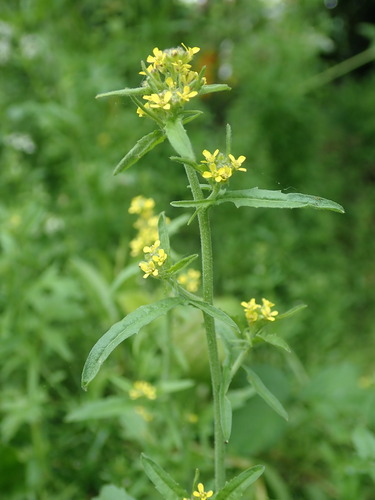
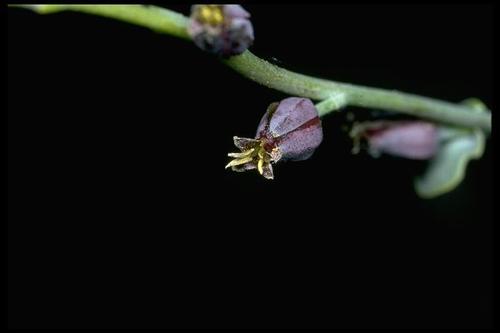
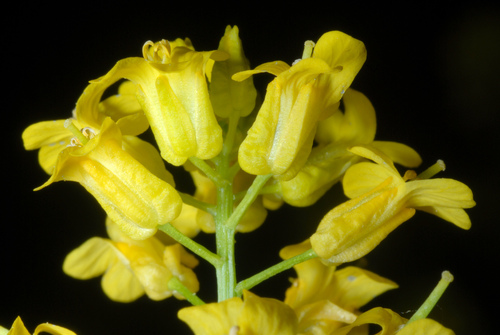
Barbarea vulgaris (L.) W.T.Aiton is an herb that grows to 80 cm (31 in) high and 25 cm (10 in) wide. Its stem is ribbed, hairless, and branched at the base. It forms basal rosettes of shiny, dark green leaves; the basal leaves are stalked and lyre-pinnatifid, meaning they have a large terminal lobe and smaller lower lobes. Cauline leaves are smaller, ovate, and either toothed or lobed. Flowers bloom in spring in dense terminal clusters above the foliage, are 7–9 mm (1⁄4–3⁄8 in) long, and have four bright yellow petals. The flowering period runs from approximately April through July. The fruit is a pod measuring around 15–30 mm (5⁄8–1+1⁄8 in). Chemical compounds found in this species include saponins, flavonoids, and glucosinolates, and the plant typically has a peppery taste. It is native to Eurasia and North Africa, and has become naturalized as a weed in many parts of North America and New Zealand. In North Africa, it occurs in temperate regions of Algeria and Tunisia. In Asia, it is found in Afghanistan, Armenia, Azerbaijan, the Caucasus, Georgia, Iran, Iraq, Kazakhstan, Kyrgyzstan, Mongolia, Siberia, Tajikistan, Turkmenistan, Turkey, China (provinces of Heilongjiang, Jiangsu, Jilin, and Xinjiang), and Japan (provinces Hokkaido, Honshu, Kyushu, Ryukyu Islands, and Shikoku). It also grows in tropical parts of Asia, specifically India (provinces Sikkim, Himachal Pradesh, Jammu and Kashmir, Tamil Nadu, Uttar Pradesh, and Arunachal Pradesh), Pakistan, and Sri Lanka. In Europe, it is found across eastern Europe (Belarus, Estonia, Latvia, Lithuania, Moldova, Ukraine), middle Europe (Austria, Belgium, the Czech Republic, Germany, Hungary, the Netherlands, Poland, Slovakia, Switzerland), northern Europe (Denmark, Ireland, Sweden, United Kingdom), southeastern Europe (Albania, Bosnia and Herzegovina, Bulgaria, Croatia, Greece, Italy, Montenegro, North Macedonia, Romania, Serbia, Slovenia), and southwestern Europe (France, Portugal, Spain). This plant favors fresh or moist locations, including roadsides, river banks, arable land, wastelands, docklands, slopes, and ditches, growing at altitudes from 0 to 2,500 m (0–8,202 ft) above sea level. In Britain, it can also be found in hedgerows and at woodland edges. It grows well in siliceous, calcareous, sandy, alluvial, and clay soils. Several natural chemotypes with distinct ecological traits have been documented in this species. A pubescent (hairy) chemotype called the "P-type" has been recorded from southern Scandinavia and Russia. This chemotype is rare in Scandinavia, but appears to be dominant in Russia according to the only survey completed to date. It has unusual chemical makeup and lacks resistance to the diamondback moth and the flea beetle Phyllotreta nemorum. Morphologically, the P-type belongs to the variety B. vulgaris var. arcuata, but may also be identical to the variety originally described as Barbarea arcuata Rchb. var. pubescens N. Busch. In this classification framework, the common form of B. vulgaris var. arcuata is called the "G-type", named for its glabrous (hairless) leaves. The G-type is reported to be dominant in Central Europe. More than 22,000 genes (89% of genes tested) show fixed genetic differences between the P-type and G-type. A different chemotype with unusual glucosinolate content, named the "NAS-type" because its glucosinolate content is dominated by glucoNASturtiin, has been described from Western and Central Europe. This type has increased resistance to some specialized insects. In this classification, the common chemotype of B. vulgaris is called the "BAR" type, after its dominant glucosinolate glucoBARbarin. While the P-type and G-type differ across multiple genetic, chemical, and morphological features, the NAS and BAR types are a simple monogenic variation. For this reason, researchers have suggested referring to NAS and BAR as forms (the lowest botanical rank of forma) and to P and G as types. Occasional NAS form plants in Central Europe have indeed been confirmed to be G-type when tested with genetic markers. Young leaves of Barbarea vulgaris can be eaten raw or cooked. Its buds, flowers, and cooked flower shoots are also edible. It can also be used as a dead-end trap crop for diamondback moth, a caterpillar pest that attacks cruciferous crops such as cabbage.