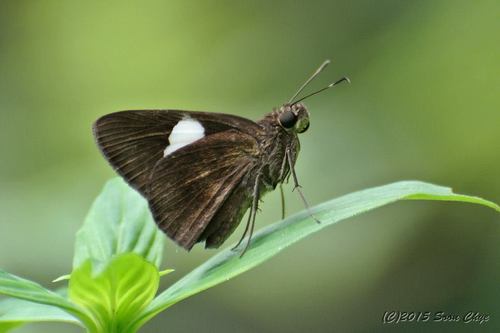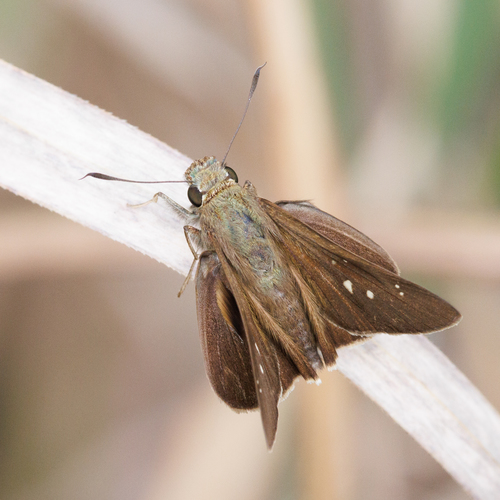
About Baoris farri (Moore, 1878)
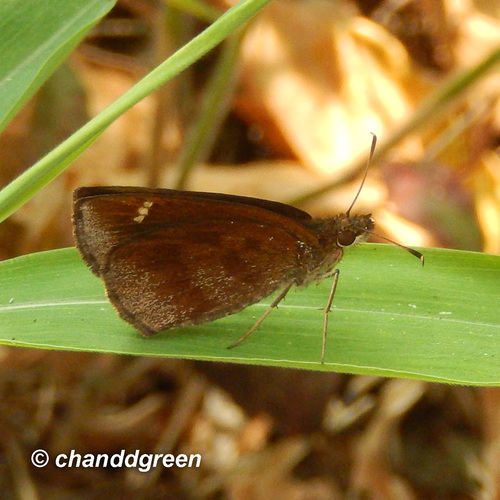
This species, Baoris farri (Moore, 1878), is described for both male and female adult individuals. The upperside of the wings is ferruginous-brown, with the base of both wings colored olive-brown. The cilia are yellowish-cinereous. The forewing has two pale semi-diaphanous spots at the end of the cell, plus a recurved discal series of seven spots. In this series, the four upper spots and the seventh spot are the smallest. The upper three spots are contiguous and placed obliquely before the apex. The sixth spot is located below the end of the cell, and it is the largest of the seven spots. On the underside, females have greyer brown coloration than males. The forewing markings match those of males, except the lowest spot is more diffused. The hindwing has no spots. Known host plants that Baoris farri larvae breed on are Ochlandra travancorica, Ochlandra scriptoria, Bambusa striata, and Bambusa wamin.