About Banksia speciosa R.Br.
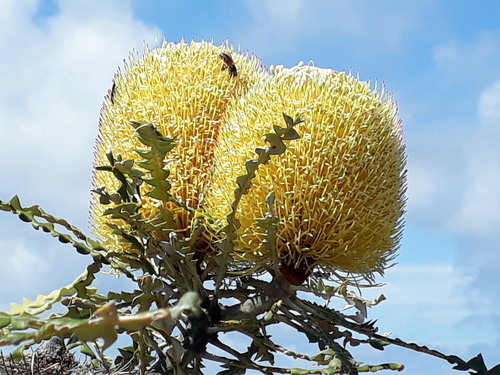
Banksia speciosa R.Br. grows as a shrub or small tree, reaching 1 to 6 metres tall, rarely up to 8 m. It has an open, many-branched growth habit, growing from a single trunk with smooth grey bark. Unlike many other banksias, it does not develop a lignotuber. New summer growth is covered in rusty-coloured fur. Its long thin leaves are linear, measuring 20–45 cm long and 2–4 cm wide. The leaf edges have a zigzag pattern formed by 20 to 42 prominent triangular lobes, each 1–2 cm long and 1–2.5 cm wide. V-shaped gaps between the lobes extend almost to the leaf midrib, and leaf margins are slightly recurved. On the underside of each lobe, 3–10 nerves converge toward the lobe tip. The midrib is raised on the leaf undersurface; new leaf undersides are covered in white hair, while mature ones have brownish hair. Cream to yellow cylindrical flower spikes, called inflorescences, can emerge at any time of year from the ends of one- or two-year-old stems, with a domed apex. At flowering, they measure 4–12 cm high and 9–10 cm wide. Each spike is a compound floral structure made of many individual flowers growing from a central woody axis. A field study on southern sandplains recorded an average of 1369±79 individual flowers per spike. The perianth is grey-cream in bud, and turns more yellow or cream when mature. The style is cream, and the tip of the pollen-presenter is maroon. As spikes age, they turn grey and retain old flowers; each mature spike develops up to 20 large red follicles. Each roughly oval follicle juts prominently from the spike, measuring 3.5–5 cm long, 2–3 cm wide, and 2–3 cm high. It is covered in dense fur, starting red-brown when young and fading to grey with age. Follicles stay closed until opened by bushfire, and contain one or two viable seeds. The seed is 3.7–4.5 cm long, fairly flattened, and consists of a 1–1.4 cm long by 0.9–1.2 cm wide seed body and a papery wing. One outer surface of the seed is grey, while the other is dark brown; on the dark brown side, the seed body protrudes and is covered in tiny filaments. Seeds are separated by a dark brown seed separator that matches the approximate shape of the seeds, with a depression to hold each adjacent seed body. The separator is 3.7–4.5 cm long and 2–2.5 cm wide. Seedlings have dull green cotyledons that are wider than they are long, measuring 1.4–1.5 cm across and 1.2–1.3 cm long; Alex George described them as "broadly obovate". Each cotyledon has a 2 mm auricle at its base, and three faint nerve-like markings on its lower half. The hypocotyl is smooth and red. Seedling leaves grow in opposite arrangement, and are deeply serrated into three triangular lobes on each side. The seedling stem is covered in white hair. A variant from the Gibson area has an upright growth habit and upright leaves. Aside from this variant, Banksia speciosa shows very little morphological variation across its entire range. Combined with its vigour and prominence in its native habitat, this led Alex George to suggest it is a recently evolved species among its relatives. Banksia baxteri closely resembles B. speciosa and grows alongside it at the western edge of B. speciosa's range, but B. baxteri has shorter, wider leaves with larger lobes, shorter flower spikes, and grows as a smaller, more open shrub. B. speciosa grows on coastal dunes and sandplains in the Esperance Plains and Mallee biogeographic regions on the south coast of Western Australia. Its range extends east from East Mount Barren in Fitzgerald River National Park and the area near Hopetoun to Israelite Bay, generally staying within 50 km of the coast. Inland, the range reaches as far as Mount Ragged and 25 km southwest of Grass Patch. There is an outlying eastern population at Point Culver on the Great Australian Bight. It grows on flat or gently sloping land on deep white or grey sand, and is often the dominant shrub in shrubland communities. It is commonly found growing alongside Lambertia inermis, Banksia pulchella, and B. petiolaris. The prominent flower spikes of B. speciosa are visited by many species of birds and insects. Honeyeaters are common visitors, especially the New Holland honeyeater, along with the fuscous honeyeater, western wattlebird, and western spinebill. Other birds recorded foraging on B. speciosa include the grey butcherbird and thornbill species. Recorded visiting insects include ants, bees, wasps, butterflies, moths, flies, and beetles. The short-billed black cockatoo breaks off old cones with follicles to eat the seed, often doing so before the seed is fully ripe. B. speciosa is serotinous, meaning it stores an aerial seed bank in its canopy within the follicles of old flower spikes. Fire opens these follicles and releases large numbers of seeds, which germinate and grow after rain. Seed can remain viable for many years; 11 to 12 year old old spikes have been found to still hold 50% viable seed. Flower spikes tend to develop similar numbers of follicles regardless of the age of the parent plant. Young plants begin flowering three years after regenerating from bushfire, and progressively store more old flowerheads and seed in their canopy as they age. In one study, 10-year-old plants averaged around 3.5 old cones, while 21-year-old plants held 105 old cones, and were calculated to contain over 900 viable seeds per plant. Plants are known to live at least 40 years, as healthy, vigorous 40-year-old individuals have been recorded. An experimental burn that monitored subsequent seedling germination and growth found that while B. speciosa produces large numbers of seeds, it has low seedling establishment rates. However, its seedlings can access water more easily and have higher two-year survival rates than co-occurring Banksia species. While this suggests B. speciosa may outcompete related Banksia species, the study authors noted that other unmeasured factors may be at play in natural environments. B. speciosa is extremely sensitive to dieback caused by the pathogen Phytophthora cinnamomi. Populations in Cape Le Grand and Cape Arid National Parks have dropped drastically, as entire populations have died after exposure to the pathogen, and it acts as an indicator species for the presence of the disease. Nursery grown plants in Italy have died from root and basal stem rot caused by the pathogen Phytophthora taxon niederhauserii. The tiny sac fungus Phyllachora banksiae subspecies westraliensis has only been found growing on the leaves of B. speciosa. It appears as round, flat, cream-coloured spots 1–3 mm in diameter on the upper leaf surface; surrounding leaf tissue sometimes develops an orange discoloration. One or two shiny black fruit bodies, measuring 0.25–0.75 by 0.25–1 mm, form in the center of each spot. B. speciosa is a fast-growing, attractive plant that grows easily in sunny spots in dry climates, in well-drained soil. It does not grow well in areas with humid summer climates, such as Australia's east coast. It has been successfully grafted onto Banksia serrata and B. integrifolia to allow cultivation in these humid climates. Seeds require no special treatment before sowing, and germinate in 27 to 41 days. A specimen flowered in a greenhouse at the Royal Botanic Garden Edinburgh in 1830. B. speciosa is an important commercial cut flower crop. It was one of several species evaluated for commercial cultivation in Tenerife, and trials found its seedlings are moderately tolerant to salinity.