About Banksia serrata L.fil.
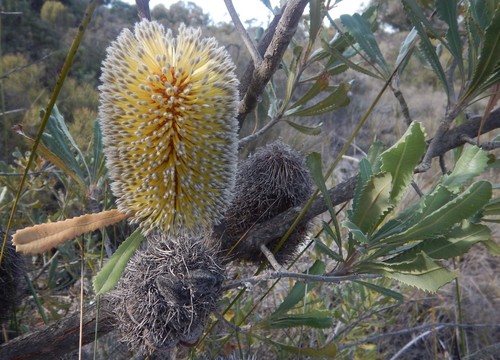
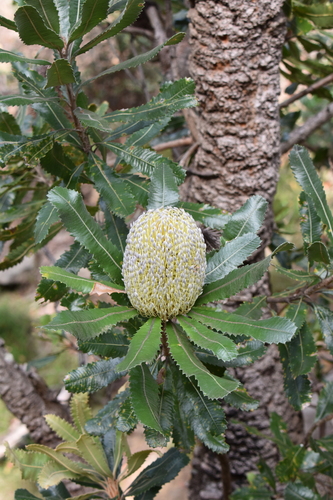
Banksia serrata, formally Banksia serrata L.fil., most often grows as a gnarled, misshapen tree reaching up to 16 m (50 ft) tall. In some coastal habitats it grows as a 1–3 m (3–10 ft) shrub, and has even been recorded as a prostrate shrub on exposed coastal cliffs. Trees usually have a single, stout trunk covered in warty, knobbly grey bark up to 3 cm (1.2 in) thick; trunks are often blackened by past bushfires, and ooze red sap when injured. New growth emerges in spring, summer, and autumn. New branchlets are hairy, and stay hairy for two to three years. Leaves are typically crowded at the upper ends of branches, giving the canopy a thin, sparse appearance. Individual leaves are dark glossy green on the upper surface and light green below, 7 to 20 cm (2.8 to 7.9 in) long, rarely up to 26 cm (10 in), and 2 to 4 cm (0.8 to 1.6 in) wide, rarely up to 4.5 cm (1.8 in), with an oblong to obovate (egg-shaped) shape. Leaf margins are serrated, except near the base, with lobes 1 to 3 mm (0.04 to 0.12 in) deep. Cylindrical flower spikes, or inflorescences, grow from the ends of 1- to 2-year-old branchlets and have leaves at their base. The spikes are generally 9 to 12 cm (3.5 to 4.7 in) wide, with hundreds of individual flowers growing from an upright woody axis that is 7 to 15 cm (2.8 to 5.9 in) high and 0.9 to 1 cm (0.35 to 0.39 in) wide. The flowers are cream-grey with cream styles. After flowering, old spikes develop into "cones" made up of up to thirty follicles, which form from pollinated flowers. Old withered flower parts remain attached to the cones, giving them a hairy appearance. Each follicle is oval, wrinkled, covered in fine hair, and measures 2.5–3.5 cm (1.0–1.4 in) long, 2.0–2.5 cm (0.8–1.0 in) thick, and 1.5–2.2 cm (0.6–0.9 in) wide. The obovate seed is fairly flattened, 3–3.4 cm (1.2–1.3 in) long, has a papery wing, and weighs around 77.5 mg (0.0027 oz). It is made of an obovate seed body that contains the embryonic plant, which measures 1.0–1.2 cm (0.39–0.47 in) long by 0.9–1.1 cm (0.35–0.43 in) wide. One side of the seed, called the outer surface, is pitted and dark brown, while the other side is brown-black, warty, and slightly sparkly. A sturdy dark brown seed separator, shaped similarly to the seeds with a depression that holds the adjacent seed body, separates seeds inside the follicle. The first pair of leaves (cotyledons) produced by seedlings are obovate, dull green, and measure 1–1.4 cm (0.39–0.55 in) long by 1–1.5 cm (0.4–0.6 in) wide. The auricle at the base of each cotyledon is pointed and 0.2 cm (0.08 in) long. The hypocotyl is thick, hairy, and red. Subsequent seedling leaves are linear to lance-shaped with the narrow end toward the base, 3.5–10 cm (1.4–3.9 in) long, with serrated margins and a v-shaped sinus at the tip. Banksia serrata closely resembles Banksia aemula, but B. aemula can be distinguished by its orange-brown rather than greyish trunk, and adult leaves narrower than 2 cm (0.8 in). B. serrata inflorescences are generally a duller grey-yellow, have longer (2–3 mm), more fusiform or cylindrical pollen presenters on the tips of unopened flowers, and produce smaller follicles. Banksia serrata occurs on the Australian mainland from Wilsons Promontory, Victoria (39°08′ S) in the south, to Maryborough, Queensland (25°31′ S) in the north. There is also a large population at Sisters Creek in Tasmania, and another in the southwest corner of the Wingaroo Nature Reserve in the northern part of Flinders Island. A 2000 Wingaroo Nature Reserve Conservation Plan reports this Flinders Island population has around 60 to 80 individual trees, most of which are believed to be quite old, and notes evidence of slow, continuous regeneration that occurs without fire. Across its entire range, B. serrata grows on well-drained, low-nutrient sandy soils, and is often found on stabilised soil near the coast just behind the main dune system. In the Sydney region, it grows alongside other typical woodland species including yellow bloodwood (Corymbia eximia), red bloodwood (Corymbia gummifera), silvertop ash (Eucalyptus sieberi), blue-leaved stringybark (Eucalyptus agglomerata), and Sydney peppermint (Eucalyptus piperita). In the Upper Myall River region, B. serrata grows in dry sclerophyll forest on recently formed (Holocene) sandy soils or in shallow soils over varying substrates, while its close relative B. aemula grows in dry heath forest on ancient Pleistocene sands that have not been disturbed in 125,000 years. Both species grow together in intermediate communities. B. serrata is a component of the Eastern Suburbs Banksia Scrub (ESBS), a designated endangered ecological community. This community grows on windblown sands that are younger than the heathlands found further north. This species is a food source for multiple bird species. Nectar-eating birds observed feeding at its flowers include bell miner (Manorina melanophrys), noisy miner (Manorina melanocephala), white-cheeked honeyeater (Phylidonyris nigra), New Holland honeyeater (Phylidonyris novaehollandiae), crescent honeyeater (Phylidonyris pyrrhopterus), white-eared honeyeater (Nesoptilotis leucotis), brown honeyeater (Lichmera indistincta), tawny-crowned honeyeater (Gliciphila melanops), white-naped honeyeater (Melithreptus lunatus), white-plumed honeyeater (Ptilotula penicillata), yellow-tufted honeyeater (Lichenostomus melanops), eastern spinebill (Acanthorhynchus tenuirostris), red wattlebird (Anthochaera carunculata), little wattlebird (Anthochaera chrysoptera), noisy friarbird (Philemon corniculatus), spangled drongo (Dicrurus bracteatus), and rainbow lorikeet (Trichoglossus moluccanus). The yellow-tailed black cockatoo (Zanda funerea) feeds on the immature follicles. A 1988 field study found that most B. serrata flowers open at night, and recorded brown antechinus (Antechinus stuartii), sugar glider (Petaurus breviceps), eastern pygmy possum (Cercartetus nanus), and bush rat (Rattus fuscipes) as nocturnal mammalian visitors and pollinators. Other mammals recorded eating its flowers include the grey-headed flying fox (Pteropus poliocephalus), little red flying fox (Pteropus scapulatus), and common blossom bat (Syconycteris australis). Banksia serrata is a host plant for both the larval and adult stages of the banksia jewel beetle (Cyrioides imperialis). Native bees and European honey bees visit its flowers. Banksia serrata has a central taproot and few lateral roots. Clusters of fine branched proteoid roots up to 15 cm (6 in) long grow from larger roots; these roots are especially efficient at absorbing nutrients from nutrient-poor soils, such as the phosphorus-deficient native soils of Australia. Banksia serrata shows variable susceptibility to dieback caused by the pathogen Phytophthora cinnamomi: plants growing in sandier soils are more resistant than those growing in heavier soils. Plants from Wilsons Promontory were found to be sensitive, while the resistance of Flinders Island plants is unknown. The small size of the Flinders Island stand makes it vulnerable to complete eradication. For horticulture, B. serrata is valued for its gnarled lumpy bark, saw-toothed leaves, and silvery-yellow spikes in bud. It grows easily from seed collected after heating the cone. A sterile, free-draining seed-raising mixture prevents damping off. Though it is relatively resistant to Phytophthora cinnamomi dieback in cultivation, it grows best in well-drained, preferably fairly sandy soil with a pH of 5.5 to 7.5, grown in a sunny position. Summer watering helps support growth. The plant may take several years to flower, though plants grown from cuttings may flower within two years. Banksia serrata is also used for bonsai. For construction, its red-pink timber resembles English oak. It is strong, durable, and has a distinctive pattern, and has been used in boatbuilding.