About Banksia oblongifolia Cav.
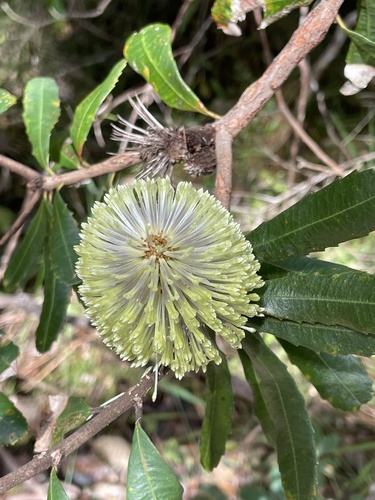
Banksia oblongifolia Cav. is a multi-stemmed shrub that grows from a woody lignotuber base. It can reach up to 3 m (9.8 ft) in height, though most plants are less than 2 m (6.6 ft) tall. Its smooth reddish-brown bark is marked with horizontal lenticels, and fades to greyish-brown as it ages. New growth, including new leaves and branchlets, is covered in rusty fur; mature leaves lose this fur and become smooth, and are arranged alternately along stems. Mature leathery green leaves measure 5–11 cm (2.0–4.3 in) long and 1.5–2 cm (0.59–0.79 in) wide. Their shape ranges from oblong to obovate (egg-shaped) or truncate, with a recessed midvein, mildly recurved margins that are entire at the base and serrated towards the leaf tip. The U-shaped spaces between the 1–2 mm long teeth are called sinuses. The underside of leaves is whitish, with a reticulated vein pattern and a raised central midrib; leaves attach to stems via 2–5 mm long petioles. Flowering occurs between January and October, with a peak in autumn and early winter (April to June). The inflorescences (flower spikes) grow from the ends of 1 to 5 year old branchlets, and often have a whorl of new branchlets growing from their base node. The yellow flower spikes measure 5–15 cm (2.0–5.9 in) high and 4 cm (1.6 in) wide; flower limbs are often blue-grey when in bud, and may occasionally be pinkish, mauve, or mauve-blue. After anthesis, flowers open to pale yellow. As spikes age, they shed their flowers and swell to up to 17.5 cm (6.9 in) high and 4 cm (1.6 in) wide, holding up to 80 follicles. The oval follicles are covered in fine fur when young, become smooth with age, and measure 1–1.8 cm (0.39–0.71 in) long, 0.2–0.7 cm (0.1–0.3 in) high, and 0.3–0.7 cm (0.12–0.28 in) wide. The bare swollen old spike, called an infructescence, has a surface patterned with short spiky persistent bracts in spots where follicles did not develop. Each follicle holds one or two obovate dark grey-brown to black seeds, which sandwich a woody separator. Seeds measure 1.2–1.8 cm (0.47–0.71 in) long overall, and have an oblong to semi-elliptic smooth or slightly ridged seed body that is 0.7–1.1 cm (0.28–0.43 in) long and 0.3–0.7 cm (0.12–0.28 in) wide. The woody separator matches the shape of the seed, with an impression where the seed body rests against it. Seedlings have bright green obovate cotyledons that are 1.2–1.5 cm (0.47–0.59 in) long and 0.5–0.7 cm (0.20–0.28 in) wide. The cotyledons sit on a 1 mm diameter, finely hairy hypocotyl (seedling stem) that is less than 1 cm high. The first seedling leaves that emerge are paired (oppositely arranged), lanceolate with fine-toothed margins, and measure 2.5–3 cm long and 0.4–0.5 cm wide. Later seedling leaves are more oblanceolate, elliptic (oval-shaped), or linear. Young plants develop a lignotuber in their first year of growth. Banksia oblongifolia can be told apart from similar co-occurring Banksia species by several traits. It differs from B. robur by its smaller leaves and bare fruiting spikes; B. robur has more metallic green flower spikes and often grows in wetter areas within the same region. B. plagiocarpa has longer leaves with coarser serrated margins, blue-grey flower spikes in bud, and produces wedge-shaped follicles. In the Sydney Basin, B. paludosa looks superficially similar, but its leaves are more distinctly spathulate (spoon-shaped) that tend to point upward rather than downward, have white leaf undersides that lack the prominent raised midrib of B. oblongifolia, have bare new growth with no rusty fur, and retain old flower parts on aged spikes. Banksia oblongifolia occurs along Australia's eastern coast, from Wollongong, New South Wales in the south, to Rockhampton, Queensland in the north. There are also isolated populations: offshore on Fraser Island, inland at Blackdown Tableland National Park and Crows Nest in Queensland, at the base of the Glasshouse Mountains in southern Queensland, at Grafton in northern New South Wales, and at Bilpin and Lawson in the Blue Mountains west of Sydney. It grows in a range of habitats: damp poorly drained areas, along the edges of swamps and flats, in wallum shrubland, and on coastal plateaux. It is also found in open forest, woodland (on ridges or slopes), and heath. Soils are most commonly sandy or sandstone-based, though granite-based soils and clay-loams are sometimes present. In the Sydney region, associated species include heathland species such as Banksia ericifolia (heath banksia), Epacris microphylla (coral heath), and Lambertia formosa (mountain devil); in taller scrub it is found with Kunzea ambigua (tick bush) and Melaleuca nodosa (prickly-leaved paperbark); in woodland it grows under canopy trees such as Eucalyptus sclerophylla (scribbly gum) and Angophora bakeri (narrow-leaved apple). The Agnes Banks Woodland in western Sydney is listed as an Endangered Ecological Community by the New South Wales Government; here, B. oblongifolia is an understory plant in low open woodland, with Eucalyptus sclerophylla (scribbly gum), Angophora bakeri (narrow-leaved apple) and Banksia serrata (old man banksia) as canopy trees, and Banksia aemula (wallum banksia), Conospermum taxifolium (variable smoke-bush), Ricinocarpos pinifolius (wedding bush), Dillwynia sericea (showy parrot-pea) and Persoonia nutans (nodding geebung) as fellow understory species. Banksia oblongifolia plants can live for more than 60 years. They survive bushfire by resprouting from buds on their large woody lignotuber. Larger lignotubers produce the greatest total number of buds, but buds are more densely spaced on smaller lignotubers. A 1988 field study in Ku-ring-gai Chase National Park found that shoots grow longer after fire, especially when a fire has occurred within the previous four years, and that new buds develop within six months after a fire. These new shoots can grow, flower, and set seed two to three years after a fire. The woody infructescences release seeds when heat from fire opens their follicles, though a small proportion open spontaneously at other times. One field study in Ku-ring-gai Chase National Park found 10% of follicles open in the absence of bushfire, and that seeds from these follicles germinate and grow into young plants. Older plants are serotinous, meaning they store large numbers of seed in an aerial seed bank in their canopy that are only released after fire. Because seeds are relatively heavy, they do not disperse far from the parent plant. Bird species observed foraging and feeding at B. oblongifolia flowers include Anthochaera carunculata (red wattlebird), Meliphaga lewinii (Lewin's honeyeater), Lichmera indistincta (brown honeyeater), Gliciphila melanops (tawny-crowned honeyeater), Lichenostomus chrysops (yellow-faced honeyeater), Lichenostomus penicillatus (white-plumed honeyeater), Phylidonyris niger (white-cheeked honeyeater), Phylidonyris novaehollandiae (New Holland honeyeater), Philemon corniculatus (noisy friarbird), Manorina melanocephala (noisy miner), and Acanthorhynchus tenuirostris (eastern spinebill). Insects recorded visiting flower spikes include the European honey bee and ants. Wallabia bicolor (swamp wallaby) eats new shoots that grow from lignotubers after bushfire. One field study found 30% of seeds were eaten by insects between bushfires. Insects recovered from inflorescences include Arotrophora arcuatalis (banksia boring moth): younger instars of this moth eat flower and bract tissue, then tunnel into the woody spike axis as they mature, before boring into follicles to eat seeds. Other seed predators include unidentified moth species of the genera Cryptophasa and Xylorycta, plus Scieropepla rimata, Chalarotona intabescens, Chalarotona melipnoa, and an unidentified weevil species. The fungal species Asterina systema-solare, Episphaerella banksiae, and Lincostromea banksiae have been recorded growing on the leaves of B. oblongifolia. Like most other proteaceae, B. oblongifolia has proteoid roots: roots with dense clusters of short lateral rootlets that form a mat in the soil just below leaf litter. These roots improve nutrient solubilisation, allowing the plant to take up nutrients in low-nutrient soils such as the phosphorus-deficient native soils of Australia. A study of coastal heaths on Pleistocene sand dunes around the Myall Lakes found B. oblongifolia grows on slopes (wet heath) while B. aemula grows on ridges (dry heath), and the two species do not grow in overlapping areas. Manipulation of seedlings in the same study area showed that B. oblongifolia can grow longer roots to seek water than other wet heath species, and that its seedlings can establish in dry heath, but it remains unclear why the species does not naturally grow in dry heath as well as wet heath. Unlike similar situations with Banksia species in Western Australia, the two species did not appear to have negative impacts on one another. In 1818, Conrad Loddiges and his sons described Banksia oblongifolia in volume 3 of their work The Botanical Cabinet, noting that it had been brought into cultivation in 1792, where it was initially incorrectly named Banksia dentata. It flowered in November in the United Kingdom, where it was grown in a greenhouse over winter. Banksia oblongifolia is not commonly cultivated, but it adapts easily to garden conditions and tolerates most soils when grown in part-shade or full sun. It has horticultural value for the colour of its inflorescences in bud, its flowering that extends into winter, and its reddish new growth. Larger plants produce taller flower spikes. It propagates easily from seed, and young plants take five to seven years to flower from seed. Pruning can improve the shrub's appearance, and it is a potential subject for bonsai.