About Banksia marginata Cav.
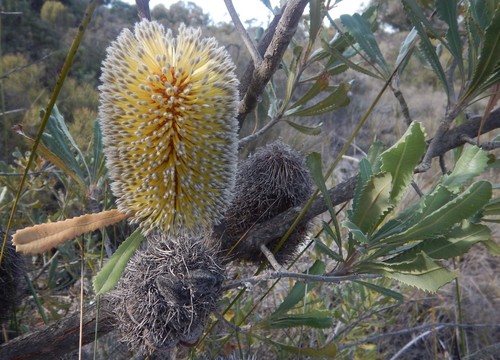
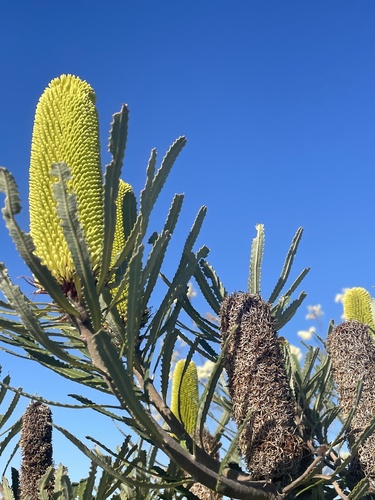
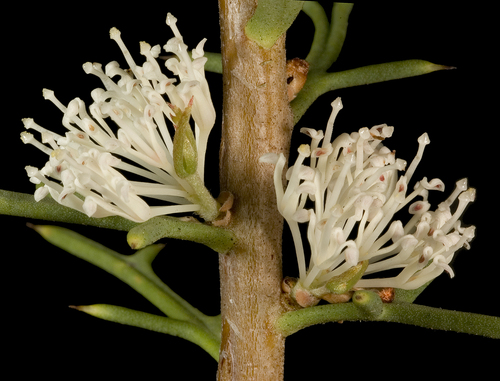
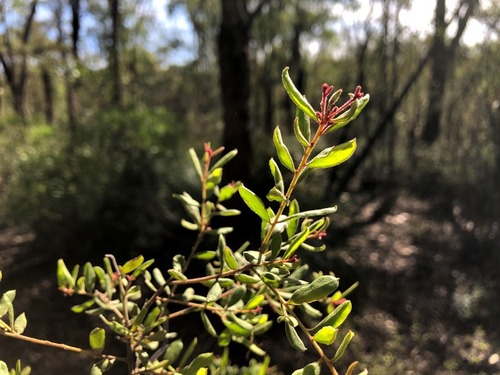
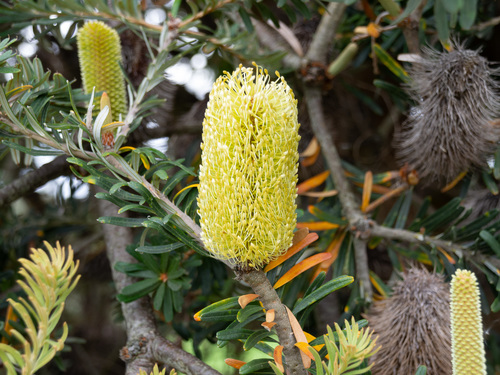
Banksia marginata Cav. is a highly variable species, typically ranging from a small shrub around 1 metre (3 ft) tall to a 12-metre-high (39 ft) tree. Unusually large trees reaching 15 to possibly 30 m (50–100 ft) have been reported near Beeac in Victoria's Western District and at multiple sites in Tasmania, while compact shrubs only 20 cm (7.9 in) high have been recorded on Tasmanian coastal heathland, such as at Rocky Cape National Park. In Gibraltar Range National Park, shrubs only reach 2 m (6.6 ft) high. The bark is pale grey, starting smooth and developing fine tessellation as it ages. New branchlets are hairy when young, lose their hairs as they mature, and new growth is pale or pinkish brown. Leaves are alternately arranged on stems, borne on 2–5 mm long petioles. Juvenile or young leaves are characteristically toothed, and 3–7 cm (1.2–2.8 in) long. Narrow adult leaves are dull green, generally linear, oblong or wedge-shaped (cuneate), and measure 1.5–6 cm (0.6–2.4 in) long and 0.3–1.3 cm (0.1–0.5 in) wide. Leaf margins become entire as leaves age, and the leaf tip is most commonly truncate or emarginate, though it can also be acute or mucronate. Leaf tissue shows evidence of lignification, making the leaves somewhat stiff, and leaves have sunken stomates. The leaf undersurface is white, with a prominent midrib covered in brownish hairs. Its complex cylindrical flower spikes, called inflorescences, generally appear from late summer to early winter (February to June) in New South Wales and Victoria, while flowering occurs in late autumn and winter in the Gibraltar Range. The flower spikes are built from a central woody axis, with a large number of compact floral units growing perpendicularly from this axis. Flower spikes measure 5–10 cm (2–4 in) tall and 4–6 cm (1.6–2.4 in) wide. They are pale yellow, hold up to 1,000 individual flowers (784 recorded in the Gibraltar Range), and grow from nodes on branchlets that are at least three years old. Sometimes two flower spikes can grow from successive nodes in the same flowering season. Late buds often have a grey or golden tinge. Like most banksias, Banksia marginata has acropetal anthesis: individual buds open starting from the base of the flower spike and moving upward. Over time, flower spikes fade to brown then grey, and old flowers generally remain attached to the cone. Woody follicles develop in the six months after flowering, with up to 150 follicles growing on a single flower spike, though only a few follicles develop in many populations. The small elliptic follicles measure 0.7–1.7 cm (0.3–0.7 in) long, 0.2–0.5 cm (0.1–0.2 in) high, and 0.2–0.4 cm (0.1–0.2 in) wide. In coastal and floodplain populations, follicles usually open spontaneously to release seed, while follicles generally stay sealed until opened by fire in plants from heathland and montane habitats. Each follicle holds one or two fertile seeds, with a woody dark brown separator shaped similarly to the seeds positioned between them. Seeds are 0.9–1.5 cm (0.4–0.6 in) long, egg- to wedge-shaped (obovate to cuneate), and consist of a dark brown membranous "wing" 0.8–1.1 cm (0.3–0.4 in) wide, plus a wedge- or sickle-shaped (cuneate–falcate) seed proper that measures 0.5–0.8 cm (0.2–0.3 in) long by 0.3–0.4 cm (0.1–0.2 in) wide. The seed surface can be smooth or covered in tiny ridges, and often glistens. New seedlings first grow two obovate cotyledon leaves, which can remain for several months as more leaves develop. The cotyledons of Banksia marginata, B. paludosa and B. integrifolia are very similar in appearance.
Banksia marginata is found from Baradine and Gibraltar Range National Park in northern New South Wales, south through Victoria and South Australia, and across all of Tasmania. It also grows on the major islands of Bass Strait, including King, Flinders and Cape Barren Islands. There is a single reported collection from the Springbrook Mountains, southwest of Southport in southeastern Queensland. It is extremely rare in southwestern New South Wales. In Victoria, it is predominantly coastal or near-coastal east of Traralgon, but it is absent from coastal areas in the Sydney region of New South Wales. Banksia marginata often grew as a large tree on the basalt plains west of Melbourne, but has almost disappeared from this area. Near Adelaide, it was once common in the western suburbs on old sand dunes behind beach foredunes, and remains common in the Adelaide foothills. Across its distribution, annual rainfall ranges from 400 to 1,000 mm (16 to 39 in). In Gibraltar Range National Park, it is a dominant shrub in open heathland and a non-dominant shrub in closed heath, growing mostly in swampy heath associated with sedges. Plants growing here have some degree of self-compatibility. In the Sydney region, it grows in heathland alongside Banksia ericifolia, B. serrata, Lambertia formosa, Persoonia lanceolata and Angophora hispida, and in forested areas alongside Eucalyptus sieberi, E. oreades, E. piperita, E. haemastoma, E. stricta, E. mannifera, E. pauciflora and Corymbia gummifera. It is a widespread understory species in medium rainfall eucalypt forests across Victoria, growing alongside Eucalyptus viminalis, E. radiata, E. obliqua, E. ovata and E. baxteri. It is a common shrub, sometimes a small tree, in heathy and shrubby forests, coastal scrub and heath across parts of its range. In South Gippsland, it is generally a shrub that regenerates from a lignotuber or suckers after bushfire and produces very few seeds. It has been recorded as a low spreading shrub in Croajingolong National Park in East Gippsland. In the Wombat State Forest west of Melbourne, it grows as a 1 to 2 m (3.3 to 6.6 ft) high shrub on less fertile soils, and as a large tree up to 8 m (26 ft) on more fertile soils. Few trees remain here, as most have been cleared for agriculture or for fuel. Further west in the Corangamite region, it grows as either a tree or a suckering shrub. In Tasmania, Banksia marginata grows in a very wide range of habitats: it grows as a small tree in mixed forest, and also occurs in buttongrass moorlands, flood plains of the Loddon, Franklin and Huon Rivers, and coastal regions. In parts of western and southwestern Tasmania, the species is dominant within the threatened native vegetation community called Banksia marginata wet scrub. There is no macrofossil record for the species, so it is unclear whether it is a recent introduction from the Australian mainland or only recently evolved, though its presence on both the mainland and Tasmania suggests it has been present since the Pleistocene. It grows in coastal habitats that would be occupied by Banksia integrifolia on the mainland. Banksia marginata grows on a wide variety of soil types, including clay loams, shale, peaty loams, and sandy or rocky soils composed of quartzite, sandstone, limestone or granite, though sandier soils are the most common. It is restricted to sandy soils in the Adelaide region. Soils across its range cover a wide pH range, from highly acidic soils in the Grampians to alkaline soils in South Australia. Plants have been recorded at altitudes from sea level up to 1,200 m (3,900 ft) AHD at Mount Field National Park.
Numerous bird species forage and feed on its flowers, including Trichoglossus moluccanus, Glossopsitta concinna, Parvipsitta porphyrocephala, Cyclopsitta diophthalma, Anthochaera carunculata, A. chrysoptera, A. paradoxa, Acanthagenys rufogularis, Caligavis chrysops, Gavicalis virescens, Ptilotula penicillata, Melithreptus gularis, M. brevirostris, M. lunatus, Phylidonyris pyrrhopterus, P. novaehollandiae, Gliciphila melanops, Acanthorhynchus tenuirostris, Manorina melanocephala, Zosterops lateralis and Acanthiza species. In addition, Zanda funerea feeds on its seeds. Antechinus agilis, Rattus fuscipes, Acrobates pygmaeus, and Petaurus breviceps have all been recorded visiting its flower spikes. Cercarteus concinnus consumes both pollen and nectar from the species. Ants, native bees, European honeybees, blowflies and brown butterflies have also been recorded as visitors to flower spikes. The wasp Mesostoa kerri, a member of subfamily Mesostoinae in the family Braconidae, causes stem galls on B. marginata in southeastern South Australia. Galls can be round, up to 3.3 cm (1.3 in) in diameter, or cigar-shaped, up to 15 cm (5.9 in) long. It is unclear what effect these galls have on the plant. B. marginata is a host plant for the larval and adult stages of the buprestid beetle Cyrioides imperialis. The banksia longicorn beetle (Paroplites australis) causes much more damage: it bores holes into the base of banksia plants, which weakens the plant until it falls or blows over in wind and dies. Several species of fungus have been recorded growing on the foliage, including Acrospermum gaubae, Argopericonia elegans, Asterina systema-solare, Botryosphaeria banksiae, a Cladosporium species, Cooksonomyces banksiae, Dimerium banksiae, Episphaerella banksiae, a Periconiella species, Satchmopsis australiensis, Tryssglobulus aspergilloides, and a Veronaea species. Like all banksias, Banksia marginata has developed proteoid (cluster) roots to adapt to the nutrient-poor conditions of Australian soils, which are particularly low in phosphorus. Suckering forms of Banksia marginata found in Victoria and South Australia have a characteristic root system: a deep tap root, plus an extensive system of thick lateral roots located 7.5–15 cm (3.0–5.9 in) below the soil surface. During winter, 30 cm (0.98 ft) long segments of these lateral roots develop vegetative buds capable of growing into suckers. Clusters of fine proteoid roots up to 15 cm (5.9 in) long grow from these lateral roots. The species' response to fire is variable. In the Gibraltar Range and Sydney regions, plants are killed by fire and regenerate from seed. They are serotinous, storing seed in old cones to form a canopy seedbank that releases seed after bushfire. A field study found seeds disperse only short distances, generally 8 m (26 ft) or less, and seeds closest to the parent plant have the highest survival rate. In Little Desert National Park in northwestern Victoria and eastern South Australia, it grows as a low shrub that produces suckers (new shoots from lateral roots) after fire. Plants do not appear to live longer than 25 years; after this time, ageing plants begin to die and are replaced by younger plants growing from suckers around the parent plant. A field study in Gippsland found counting nodes on Banksia marginata plants accurately estimates age within one year, up to 21 years after the last fire. There is anecdotal evidence of plants reaching 150 years old in this region. Plant species from fire-dependent communities are thought to evolve to be more flammable; when tested from a dry sclerophyll community in southeastern Tasmania, Banksia marginata burned readily, and fire spread easily through it. Tasmanian forms are frost tolerant at any time of year, which may explain their success spreading and growing in different habitats across the island. This trait may also have allowed them to survive cold Pleistocene periods in Tasmania. A trial in Western Australia found Banksia marginata to be mildly sensitive to Phytophthora cinnamomi dieback. At Brisbane Ranges National Park west of Melbourne, which was invaded by Phytophthora cinnamomi in the 1970s, Banksia marginata (along with species such as Grevillea steiglitziana) became part of the secondary regrowth of understory species after more resistant shrubs, grasses and sedges had grown back.
Many Aboriginal clans and tribes across the east coast of Australia used this plant. They sucked the sweet nectar from the flowers or drained it by soaking nectar in water, and in some cases mixed it with wattle gum to make a sweet lolly. The wood was also used to make needles. The Gunditjmarato peoples of western Victoria used spent flower cones to strain water, placing the cones in their mouths and using them like straw.
Banksia marginata was first cultivated in England in 1802, where it was also listed under the synonyms B. australis, B. insularis and B. marcescens. It was grown at Kew, Cambridge Botanic Gardens, Woburn Abbey, and private gardens in Chelsea, Hackney and Harringay House. One glasshouse-grown specimen at Kew was recorded as a 7.3 m (24 foot) tree with a 60 cm (2 foot) trunk girth at 40 years of age. B. marginata is generally fairly easy to grow in a well-drained, sunny or partly shaded garden position. It becomes leggy in shadier positions, and grows as a more compact bushy shrub in full sun. Some varieties from drier areas tend to grow poorly in regions with summer humidity. The flowers are not prominent unless large numbers are produced. Established plants can tolerate drought, coastal exposure and temperatures as low as −10 °C (14 °F). Plants can be propagated by seed or cuttings; cuttings are required to preserve the habit of particular plants, such as dwarf specimens. Some Banksia marginata seeds from subalpine sources require stratification: holding them at 5 °C (41 °F) for 60 days before germination occurs over 6 to 25 days. Alf Salkin proposed this is necessary so that seed released after a summer or autumn bushfire stays dormant over winter before germinating in spring. Seeds of Banksia saxicola and Banksia canei share this trait. Some dwarf forms are commercially available in Australian nurseries, though some selections do not stay dwarf when grown in cultivation. Banksia 'Mini Marg' is a small form selected from the northeastern coast of Tasmania that reaches 30 cm (12 in) high and 1 m (3.3 ft) wide. 'Mallacoota Dwarf' was selected from a natural population at Mallacoota, Victoria. Salkin reported that a form from Kanangra Walls with peach-tinged growth, and a prostrate form from Cape Liptrap in Victoria, both have horticultural potential. Banksia marginata and its dwarf cultivar 'Mini Marg' have also been used for bonsai.