About Banksia littoralis R.Br.
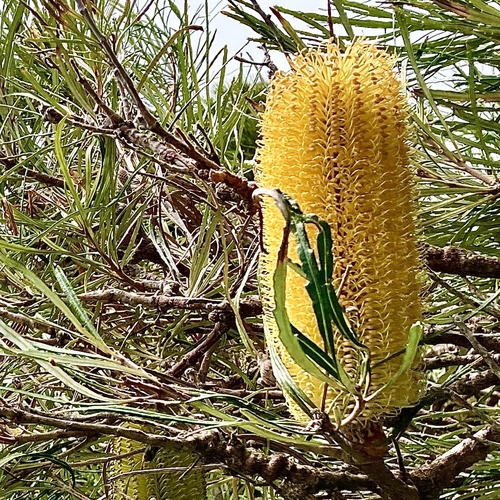
Banksia littoralis is a tree that typically grows between 1.5 and 12 metres (4 ft 11 in to 39 ft 4 in) tall, occasionally reaching 25 metres (82 ft). It has rough, crumbly bark and stems covered in woolly hairs. Its leaves are arranged in whorls, shaped linear, usually serrated on the upper half. Each leaf measures 70–230 mm (2.8–9.1 in) long, 4–18 mm (0.16–0.71 in) wide, and sits on a 5–10 mm (0.2–0.4 in) long petiole. Flowers form in a cylindrical head that is 70–200 mm (2.8–7.9 in) long and 60–70 mm (2.4–2.8 in) wide when the flowers open. The flowers are yellow, with a 25–27 mm (0.98–1.06 in) long perianth and a hooked pistil 29–35 mm (1.1–1.4 in) long. Flowering occurs from March to July. After old flowers fall off, the resulting follicles are broadly linear to narrow elliptical, measuring 11–22 mm (0.4–0.9 in) long, 2.5–8 mm (0.1–0.3 in) high, and 4–8 mm (0.16–0.31 in) wide. Each head can sometimes hold up to two hundred follicles. This species, commonly called swamp banksia, grows in coastal areas of southwestern Western Australia, covering the Wheatbelt, Peel, South West and Great Southern regions. It is most often found along creeks and rivers, in low-lying, seasonally damp sites including swamps and depressions, growing well in high-moisture peaty to sandy soils. It is often a member of low woodland communities, typically associated with Melaleuca preissiana, and also occurs in Eucalyptus gomphocephala forest communities. It is rarely found in low coastal kwongan communities. Its native range stretches from Mount Lesueur in the north to Cape Leeuwin in the southwest, extending east to Two Peoples Bay and the Stirling Range. For horticultural use, Banksia littoralis is relatively easy to cultivate. It may be less sensitive to dieback than other western banksia species. Its seeds need no pre-treatment before planting, and germinate in 20 to 36 days.